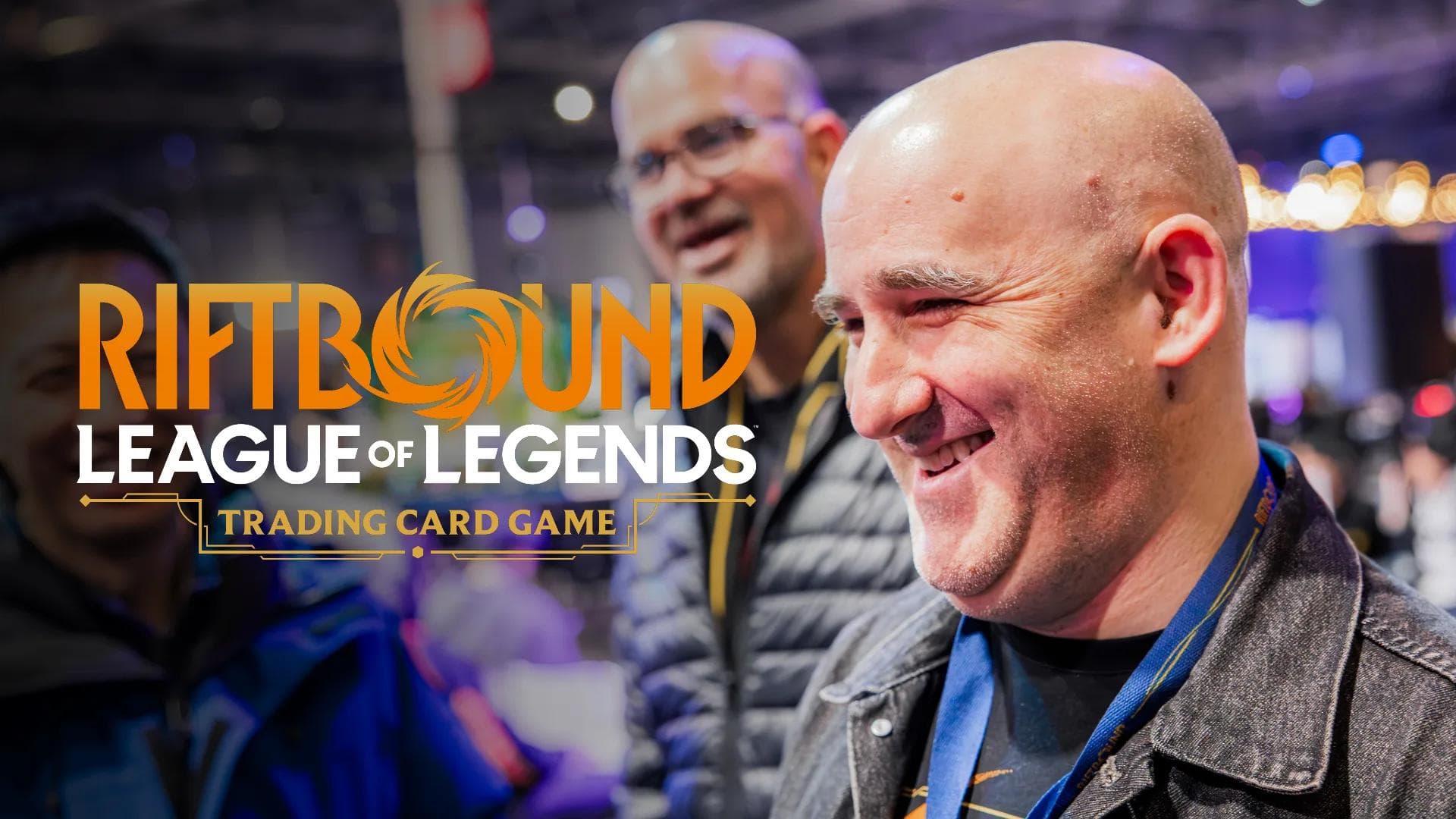
Dave Guskin: “We have to be careful about the amount of complexity we introduce, to make sure that we keep Riftbound approachable”
Riftbound's Game Director talks distribution, new languages, and possible simil Secret Lair releases.
00
Share
Dave Guskin
"I think Riftbound is kind of best suited for playing with a group of friends"
Loading...
Loading...
One year after its first player testing at the Teamfight Tactics’ Macao Open, Riftbound welcomed hundreds of people at the TFT Paris Open this weekend. From demos to tournaments, attendees at the event had the opportunity to play Riot Games’ card game and see how far it has come since its first public showing. Speaking with Sheep Esports,Riftbound’s Game Director Dave Guskin looked back on that initial reveal at the TFT Open in Macao, which followed internal testing at Riot and smaller playtests in China and Los Angeles. One year on, Guskin says the game is doing very well, pointing to strong player excitement at live events, in local stores, and across social media.
What has stood out most to him, however, is the diversity of the player base discovering Riftbound. Guskin noted a growing number of players bringing in friends who had never played trading card games before, alongside veterans coming over from other TCGs to try something new. This mix of newcomers and experienced players, combined with active conversations around decks and strategies, highlights Riftbound’s momentum as it continues to establish itself within the competitive card game scene. However, the crucial moment that will define the long-term health of the game has yet to arrive.
Some could say that the TCG market is saturated, so what is a unique trait of Riftbound that sets it aside from others?
Dave Guskin: "So we built Riftbound from the ground up to be a really great in-person social multiplayer game. So I think among all the card games—the strategy card games that exist—I think Riftbound is kind of best suited for playing with a group of friends. The features like the battlefield control and being able to choose your moment to really make your big play are something that we found works really well, maybe even better than other TCGs—something that's a big strength of ours. So I think the best part is, obviously, if you love League of Legends, then you get to play with your LoL champions in this game. I think that kind of appeals to a particular part of the audience. And then for people who love TCGs, there's just a lot of cool stuff to love about the battlefields and the resource features.
So Riftbound has a multiplayer function as well, can you introduce that a bit?
Dave Guskin: So as with many TCGs, you can still play one-v-one, and our competitive formats are one-v-one. However, you can also play three or four-player Free For All, which means that everyone sits down at the table and all the battlefields are up for grabs. Everyone is trying to race to the points, the victory score of eight. And then you can also play two-v-two, which means that you sit with a partner on a team, and you score together, and you win together, and you're fighting against another team of two. And that's got some kind of interesting competitive and cooperative elements to it.
There are many players, and there are many interested in Riftbound, however an issue with Origin is that there was a bigger demand than the number of released cards. Can you tell us a bit about that?
Dave Guskin: Riftbound is a new game, and we're doing our best to estimate how much to print and how much to ship to various places based on the demand that we're hearing from players and from stores, and from distributors. And the timelines are long. So many, many, many months ago we had to make decisions about how much to print. We got as much time as we could on the printer, and we tried to make sure to ship it as fast as we could. And still I think we fell short of player demand, which is great, a good problem to have, still a problem. So we're working as fast as we can, basically, to get product in the hands of players. Part of that is printing a lot more of it, and part of it is getting it as quickly as possible into the hands of stores and players.
Is there a specific region or maybe country that you were surprised to hear it had such a big demand for Riftbound?
Dave Guskin: I don't know about surprise, but I think honestly there's a large French community that loves TCGs and they're really excited about Riftbound. I think that there was more excitement in North America and in Europe just broadly than I thought, because, as you mentioned, there are many, many TCGs out there. It's a pretty packed space, and it's kind of great to see people trying it out and liking it so much that they're telling their friends, and then there's a lot of demand and excitement for it.
And you just launched cards in French.
Dave Guskin: Yes, we have the trial deck here, which we use for demoing in French, and then we also have the special promo Altered Unity in French with cool promotional art for TFT. So, that's coming soon. I think mid-2026 is when it'll be out in the French language and booster packs.
Can players also expect other languages besides Chinese, English and French?
Dave Guskin: So we haven't announced anything yet, and I don't have any details about specific languages here, but I will say we're watching and listening. As players say, like, ‘Hey, I really like this in my language,’ we totally hear that, and we're trying to make sure that we both make a good kind of sustainable case for a language. We would rather not start printing the language, find out, "Oh no, we've [overprinted] it", and then have to stop. That's a terrible experience for players. But if there is demand and there is interest, we definitely want to hear that and make steps towards getting that to become a reality.
So in that regard, when you do international events and there is maybe a French player going to, let's say, Bologna event in February, can they use their French deck?
Dave Guskin: So you're allowed to play with any language of cards you have; you just can't mix languages in the same deck right now. I've heard a lot of player feedback actually very recently as we've announced French language cards; they're like, "Hey, can I mix French and English? I've already collected English cards," and the current rules say no, but players are saying, ‘Hey, that's really painful. I'd like to be able to do that. Is that something we're currently thinking about and discussing changing?’ But right now you can definitely [play with another language], as long as all your cards are in the same language. If I have an English deck, you have a French deck, and this other person has a Chinese deck, we're allowed to play together. You just can't mix the language inside a single deck—currently.
Would you consider doing a kind of Secret Lair collaboration or product going into the future?
Dave Guskin: Yeah, so Secret Lair is something that Magic: the Gathering does where it's a special collectible product that they'll do collaborations with special artists or with various IPs. We've certainly talked about it. I think extra special collectibles is something we're truly interested in thinking about in trying to figure out what the audience is interested in.
We added the World's collector box with League Worlds at the end of this year; we've got stuff planned for next year with the Arcane box set. So I think there's a lot of opportunity for collaboration with individual artists that's really exciting. And I speak with our creatives all the time about that, and I think there are really interesting opportunities for just special one-off collector products. Whether we do it the same way as that, I don't know, but that's something that we're still kind of in the works on.
Is there an IP that you personally, so not as game director, but as a player, would like to work with?
Dave Guskin: There are a few, I guess. Is there one that I could call out? I don't know. It is weird to think about, right? Because, well, I work on a game with an IP, is there a different IP [I want to work with]? But there are a lot of cool games that Blizzard has made. There are many single-player RPGs that I would also be really interested in maybe doing a collab with. So it's interesting to think about that. One of the interesting things about League of Legends is there are all these alternate universes in the skin lines. So I feel like there's a lot for us to explore before we move on to collab with other IPs, but I think it's something we could definitely keep talking about.
Is there a limit to what mechanics you would like to introduce in the game?
Dave Guskin: We always have to be careful about the amount of complexity we introduce. I want to make sure that we keep Riftbound approachable. Therefore, if you come in 1, 2, or 5 years from now, it's not going to be five times harder to get in. I want it to be straightforward and an easy on-ramp. So in that way we do think about how to constrain the number of mechanics and then the amount of complexity, but there are a lot of interrelated mechanics you can make. So, as an example, here's a spell mechanic, and here's a different spell mechanic. Here's the thing that cares about casting spells. All these things work together, and it's not that much more complicated to understand all three together. And so we look for ways to do that where we can help provide you with the guardrails of like, "Okay, cool, I'm playing a spell deck; here are the things I have to worry about."
And in that way it becomes easier to get batches or groups of mechanics together. So that's a way that we think about [how to introduce mechanics]. One of the hardest problems, I would say, in making content for a card game is that you make so many cards and so many sets over the years, you really have to think about how to constrain that. The other way we do it is as we make more and more sets, possibly the competitive environment, or what we expect to be played at local game stores, will be the standard format. This is only the most recent set of the past two years. So that limits the amount of complexity because you only get the total amount in two years. So it's still a lot, but it's not like the entirety of the game's amount of complexity.
More than the quantity, I was thinking of the quality of mechanics. Therefore, is there maybe a limitation based on the design of the game or based on what you think is approachable for players?
Dave Guskin: I'll honestly say that there are some mechanics we have right now that are hard to approach. For example, the hidden mechanic I think is a bit complicated. We really wanted to get this sense of ‘I'm laying a trap for you.’ That's something that's really exciting to us. I think that's a mechanic we'll keep coming back to and trying to refine and improve. But I think when you just try to learn it, it's a lot to learn for a single mechanic. Are there other mechanics [I think are complex]? I think there's a lot of stuff with multiple cards interacting to do kind of crazy things that I think we'll eventually do. But in the first year, I think we probably don't need to do that with kind of good old-fashioned Riftbound. You're just kind of learning the systems; you don't have to create some crazy engine that is just hard to process what's going on.
Travis Gafford was saying that you often really see a TCG’s health and direction once the third set comes out. Do you agree, and how do you expect Riftbound to be doing by then?
Dave Guskin: I think that's really wise. A lot of times the first set, it could be a flash in the pan, right? People are very excited, but maybe they won't stick around, or maybe there's more demand than there actually is because people are speculating on the collectibles and things like that. So I think when you see how people come back for the second set and for the third set and even the first full year, you get a good sense of who's here, who's sticking around for the long term and are they bringing in their friends? Do we still have new players coming in, and do they enjoy it? I think that's when you really learn [the health of the game]. So I do agree with that sentiment. I think it's not always exactly the third set, but I think that's a good barometer.
One other thing that I wanted to ask about is the errata corrige of the game, it's different from LoL and VALORANT because you have a physical game. So how do you approach cards that you have to tweak, but they were already printed?
Dave Guskin: In general, you can't really patch a physical card game. I'm not going to go to everyone's house with a Sharpie and change their card. Sometimes we were forced to say, “Hey, this card is not exactly the way it was written. It's like we made a typo or it doesn't work with the rules, and we just realized that.” And we hope to keep those few and far between. We had to do a few more at the beginning. New game, obviously we're learning as well as everyone else is, but then over time I expected to do many fewer of those because we can't change the text of the cards. We really have a couple of tools.
One is that we can ban cards if they're too powerful or create situations that are really unfun in gameplay; then that's always a tool we have available to us. I never like telling a person they can't play with their cards, and so that's a tool I want to use sparingly. But if a competitive environment looks really unfun or things seem like they're just not good, then we can intervene if we have to.
And then the other way we can do it is as we build new sets, we'll often spend a little bit of time thinking about things like, "Well, what's the riskiest part here? If something goes wrong, how will it go wrong?" And then we can provide tools inside the set that are kind of [counters], basically if they get really strong, but only if that risk actually happens. So, for example, if spells are really good, there's this card in the set that says, "I'm going to kill all the spells," or whatever, take them all out of your hand. That card might be really expensive and therefore really bad unless spells are really, really good, and then it becomes really strong. And so we try to put in those kinds of pressure release valves when we can. Obviously that requires us to kind of see the future a little and think about what's risky, but those are mostly the two ways we handle that sort of thing.
How would you want players to feel one year from now, having invested so heavily in bound in terms of time, finance, and resources?
Dave Guskin: I mean, I would love players to think, ‘Wow, Riftbound is my game, and it's going to be around for a long time. Like, Riot supports it.’ Our partners, who help us with print production, support it, and there's a vibrant community that I just love going to every week and playing. That's what I’d love players to kind of think and feel. I think that the best way to know that, ‘hey, this game is really something special,’ is people want to invite their friends to come play with them. Even if you don't know how it works, if you sit down at the table and you kind of get like, ‘Oh cool, there are battlefields and champions, and you have a fun time. You're still learning, and you're excited to learn’—I think that's the best outcome."
Freelance writer exploring the gaming, esports, and entertainment industries. Growing up playing games and discovering new music shaped my curiosity for the stories behind them. Today, I turn that cur...