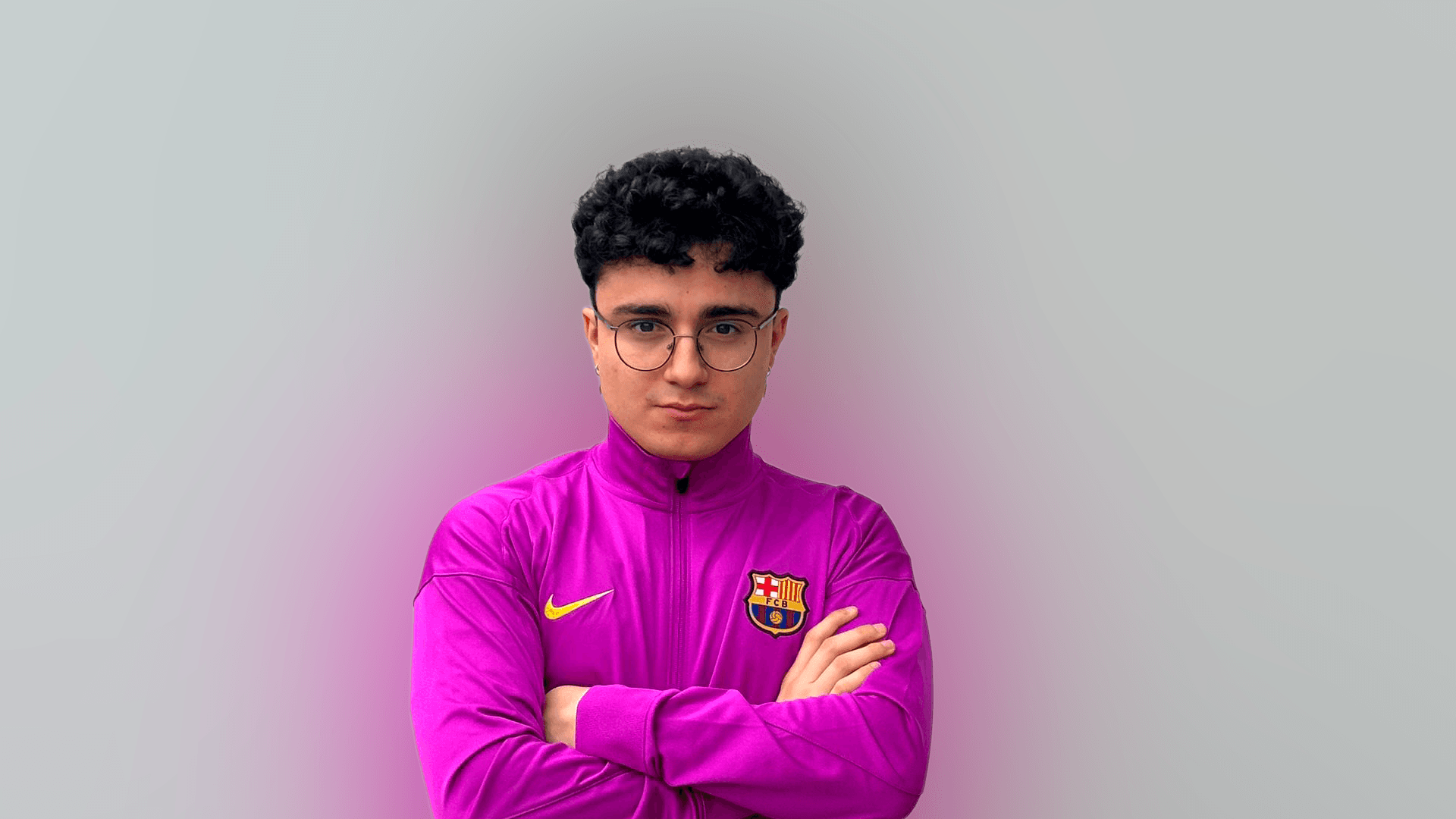
Shortly after the 2025 Iberian Cup,
Sheep Esports had the opportunity to interview Eric “
Selenex” Lozano Gutiérrez. He spoke about his beginnings in competitive
League of Legends, his rise from amateur play to the Superliga, and
the new chapter ahead with Barça Esports.
You started playing in amateur teams in 2021. What were your first steps in competitive play and Liga Nexo like?
Eric “Selenex” Lozano: “I started out with a group of friends and gradually worked my way up. I didn’t have any intention of becoming a professional player at first, but one day, a typical amateur team asks you if you want to play, offers you a small salary, and suddenly, those 60 euros feel exciting. Things really changed when I joined Rocket. That was a promotion tournament to the Superliga Second Division, and we reached the final. After that, my name started appearing on the radar of people from Liga Nexo. Once I got promoted, everything became very linear: one year to adapt, a second split in a better team, and then Superliga Segunda felt like a natural step.
During your time in Liga Nexo you played for Kawaii Kiwis. Do you think being in a team with connections to Superliga helped your development? How do you value that experience?
Selenex: Yes, at least back then, Kiwis felt like a bridge to Superliga. You had DarthYellow (Jesús Fernández Rubio), who was very involved in the project. He teaches you discipline and starts preparing you for what you’ll face higher up — what will be demanded of you and what kind of problems exist at that level. Kiwis felt like a very safe home. You’re under ‘Papi Darthy,’ and it’s almost like an academy that teaches you what playing in Superliga is really like. On top of that, having someone like him gives you contacts and opportunities.
You were later promoted to Xoldiers and then played for Stormbringers in Superliga Second Division. How did those experiences affect you?
Selenex: Xoldiers was… an adventure. I came from a very comfortable environment, and suddenly, you realize that not everyone has the same support system. You have to deal with internal issues and situations you weren’t used to before. It wasn’t a bad project, but it required much more self-management. Sometimes you even had to help teammates who didn’t yet have the tools to manage themselves. You start learning to deal with different personalities and difficulties. Stormbringers, on the other hand, were much closer to Kiwis. Chapu (Álvaro de Sancha Monslave), the CEO, creates a very family-like environment, and that really helps. We even reached the final and lost to Veni Vidi Vici, but overall it was a good experience.
How was the transition from Superliga second division to Superliga? Does everything become much more professional?
Selenex: The jump wasn’t really noticeable. I had been told that once you’re in ERLs — whether ERL1 or ERL2 — things are quite similar. The real difference is resources. Teams like Heretics, KOI, or GIANTX have so much investment that certain problems simply don’t exist. In smaller projects, things feel more amateur. In my case, I had to look for external psychological help and individual coaching on my own because there weren’t enough resources. That’s understandable — it’s a low-budget project. When we joined Guasones, we accepted that. The important thing was getting the chance to debut in Superliga.
How do you evaluate the year from a competitive standpoint?
Selenex: The main issue is that it was planned as a long-term project. The Winter roster was supposed to stay all year because we came from a lower league and needed time to develop. But internal issues led to changes, and suddenly everything shifted. We found ourselves in a situation where we could lose the slot — and that slot is worth a lot of money. The last thing we wanted was to fail the organization that gave us the opportunity. Relegations completely changed the team’s mindset. Out of ego and respect, everyone flipped the switch. All the internal conflicts disappeared because something bigger mattered. The overall evaluation of the year is bad, but I’m happy that we were able to step up when it really mattered.
How did the opportunity to play the Iberian Cup with Barça Esports come about? How was your first experience with the team?
Selenex: It’s funny, because I was actually thinking about leaving the scene. I was completely burned out after Guasones and required a break. Then one day, my agent calls me and says, "Do you want to play the Iberian Cup with Barça?" Obviously, it’s a dream to play for Barça. The club wanted to create a Spanish project for the Iberian Cup and to close out the final LVP tournament with a local roster. I think the team’s biggest issue right now is that there’s a lot of joking around — it’s impossible not to laugh. But that created bad habits that carried over into the Iberian Cup. If you’re laughing every other game and don’t have strong habits, you’re not working properly. Still, according to the staff, the level shown wasn’t far from what they wanted for 2026. They initially planned to go with foreign players, but when some pieces fell through, they thought: Why look for imports when we already have five motivated players who want to give everything?
Do you have a message for Barça Esports fans?
Selenex: They should stay calm. Even if things didn’t go well this time, there won’t be five players who work harder than us. The excitement we have for this project can’t be measured. We’ve even adapted the project, so Koldo (Luis Pérez Garcia) and Oscure (Víctor Guzmán) can keep studying. There are too many reasons for this team to work: the motivation, the resources, the desire to play together. At the very least, people will be able to smile watching Barça Esports.”
Header Photo Credit: Barça eSports