LoL: Faker meets Prime Minister Kim Min-seok to discuss his career and esports' future
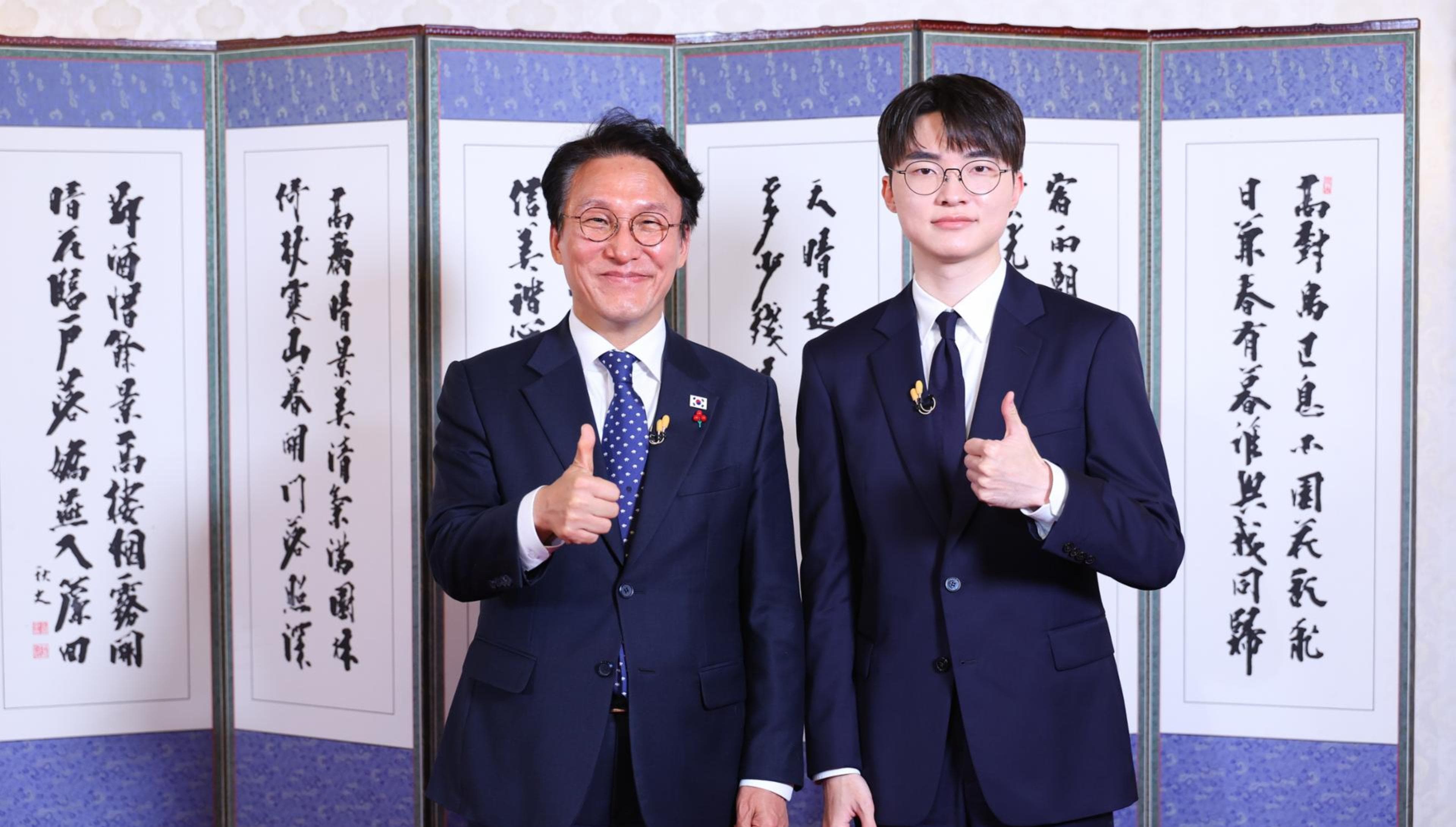
South Korean Prime Minister Kim Min-seok sat down for a 40-minute conversation with Faker, the reigning three-time world champion and esports' greatest legend.
00
Share
"Becoming a pro gamer is hard. There are probably a lot more people who want to do this now."
"I hope games can go beyond just entertainment or a way to kill time, and instead give many people inspiration and other positive influences"
Loading...
Loading...
T1 midlaner Lee “Faker” Sang-hyeok sat down for an interview with Prime Minister Kim Min-seok, which was pre-recorded and released on Saturday, November 20th, on YouTube by the Prime Minister’s Office. “Winning Worlds is like a dream for pro players,” he said. The six-time world champion didn't sugarcoat his views on the career path that made him a legend.
Despite achieving what most players can only dream of, Faker acknowledged he'd struggle to give his blessing if his own child wanted to follow in his footsteps—a sobering reminder that even esports' greatest success story recognizes the difficulties inherent to the profession.
The three-peat that felt impossible
Reflecting on T1's unprecedented run at Worlds 2025, Faker remained characteristically humble. "Winning Worlds is like a dream for pro players. This time, we were lucky enough to complete the three-peat. I never imagined we'd win three in a row," he said. "I'm grateful, and it's an honor."
The achievement represents the pinnacle of competitive League of Legends, cementing T1's dynasty and Faker's status as the undisputed greatest of all time. Yet even in victory, his mind turned to the broader challenges facing aspiring pros.
A cautious parent-to-be
When asked about supporting future generations of pro gamers, Faker called parental concerns "reasonable" and admitted he'd hesitate before allowing his own child to pursue the career. "If I became a parent, I'd want to know why my child wants to do it so badly," he explained. "Because it's a very real, practical issue, I think you'd have to find a compromise. I'd think it through together with them, but I don't think I'd be able to just readily say yes."
His skepticism stems from firsthand experience with the profession's uncertainty. "Becoming a pro gamer is hard. There are probably a lot more people who want to do this now," Faker noted. "Playing more than 10 years as a player was something that felt hard to even dream about."
Financial concerns dominated his early pro career. "After I turned pro, my worry was 'Can I actually earn a living?'" he recalled. "At first, I was also worried because it meant giving up on my studies. But as I continued my pro career, I thought that even if I couldn't make much money, it would still be a valuable experience."
Faker credited his father's support as instrumental, revealing that his father once aspired to become a baseball player but ended up in a different profession—a parallel that likely shaped his willingness to back his son's unconventional path.
Learning to lead
The 29-year-old described an unlikely transformation from isolated gamer to team leader. "I'm not really the 'leader type.' I only played games at home, so I didn't interact much with people," Faker admitted. "But after about 13 years as a pro, I started to feel the need for it."
That realization sparked deliberate self-improvement. "I read books on what a leader needs, and as I changed my actions and thoughts, I learned a lot about leadership. For the team to win, you need to be able to console and encourage people, and I felt I had to help my teammates play better."
Credit: Office of the South Korean Prime Minister.
Reading evolved from obligation to passion. "When I was younger, I didn't read books. At first, I read because I thought I should study, but as I kept reading, it became fun, and it put my mind at ease," Faker explained. "As a pro gamer, I realized, book by book, that I could apply what I read to the game. It broadened the range of things I could think about."
His physical routine has evolved alongside his mental development—he's traded running for swimming while maintaining the structured fitness programs T1 provides.
Industry critique
Despite his success, Faker offered pointed criticism of gaming's current trajectory. "Esports is world-class and hugely popular, but as far as I know, the game industry itself isn't number one yet," he observed. "I feel like the mainstream is still games that chase short-term profit."
He advocated for a shift in priorities. "Personally, I hope games can go beyond just entertainment or a way to kill time, and instead give many people inspiration and other positive influences," Faker said, suggesting the industry focus on meaningful impact over quick monetization.
Gratitude above all
Through the challenges and uncertainties, one constant has defined Faker's career: his relationship with fans. "Throughout my pro career, my sense of gratitude toward the fans has only grown," he said. "Receiving so much support and interest from so many people is really meaningful. The fans' attention and love have become my goal and motivation for continuing as a pro gamer."
It's a fitting note from a player whose legacy extends far beyond trophies—transforming esports culture while remaining grounded in the community that built him.
Header Photo Credit: Office of the South Korean Prime Minister