03.09.26 - 12:0003.09.2026 - 12:00·10m10 minutes de lecture·
Par Corentin Phalip
How the World Cyber Games pioneered national esports
From the WCG’s 2000 debut to the ENC, trace how national esports evolved into a global competition format
Loading...
Loading...
00
Partager
Wolrd Cyber Games 2001. Credit: WCG
“it's okay if it breaks”
Loading...
Loading...
“The ENC introduces national pride to the global esports stage in a recurring format and is the first event of its kind at this scale.” That is how the Esports Nations Cup was presented when it was announced a year ago, on August 24, 2025. For esports fans who came into the scene around the 2020s, the ENC is indeed a real first opportunity to see national competitions. A type of event that has relatively disappeared since COVID-19 and which was supposed to regain its former glory next November with the first edition of this new event.
However, the public will eventually have to wait for one more year. The Esports Foundation, which is in charge of the ENC and the Esports World Cup, announced on August 18 that the first edition would be postponed from November 2026 to November 2027.
In his initial announcement, the ENC puts strong emphasis on being the first recurring event of this scale, which could be debated somewhat, even if it is true that the ambitions for this first edition seem immense. Nearly 120 different nations qualified for the tournament next November, with 16 different disciplines, including the most-watched games in the world, and on top of that, some of the biggest stars from different countries were set to travel, if we leave Counter-Strike 2 aside.
Early beginnings, and then South Korea
In fact, the ambition to be “the organization that manages international esports competitions” is nothing new and dates back to 2000. However, we need to go back a few years further, to 1997, when the community around Quake launched the National Challenge. Country-versus-country matchups were made possible in large part by the release of QuakeWorld a few months earlier, which enabled genuine online competition. As early as 1997, a few matches were held between Sweden, Norway, Finland, Denmark, and the United Kingdom. A few online archives also appear to document further European matchups on Unreal Tournament, as well as clashes between Japan and the United States during the early days of the Street Fighter franchise.
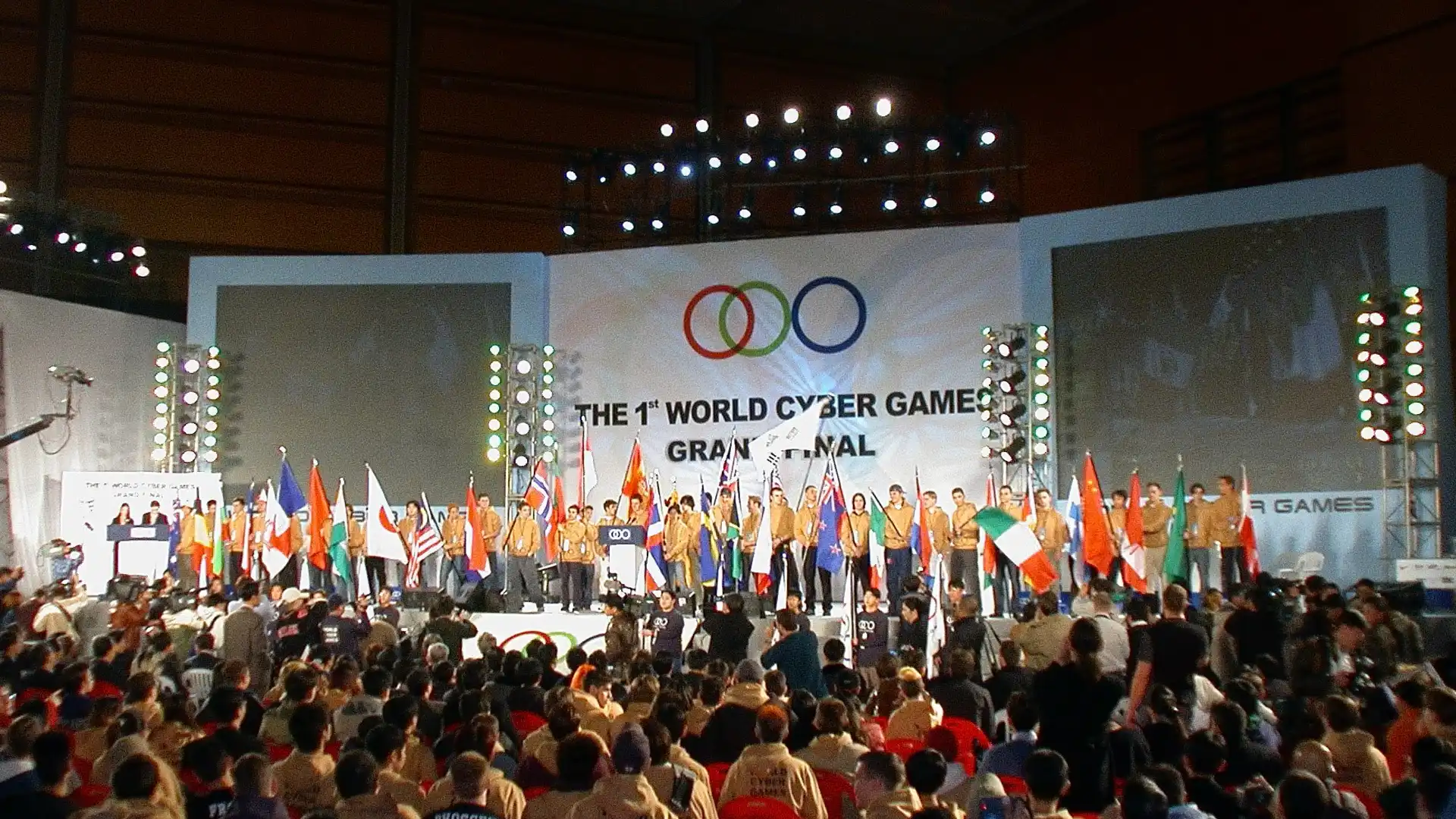
For a real starting point with a format similar to what we know today, we have to look at October 7, 2000, with the launch of the first edition of the World Cyber Games. Held for nearly a week in the city of Yongin, south of Seoul, South Korea, the event already had huge ambitions for its time, especially when compared with what exists today in this type of competition. Named WCG Challenge, this beta edition already brought together players from 17 different nations, including France, Mexico, Singapore, and Australia, alongside Korea's neighboring countries such as China, Japan, and Taiwan. In total, more than 180 players across four different disciplines gathered at Everland, the country’s largest theme park.
A fertile ground
But what made South Korea so special, and above all, why, as early as the 2000s and several years ahead of the rest of the world, was it this country that took the initiative to launch such an event? We first need to go back to 1997 and look at the Asian financial crisis that year to understand why it started here, rather than in the United States or Europe, where competitive esports already existed through the CPL and the Quake scene, which was pioneering this new format.
Following the crisis, Korea came under IMF oversight, and the government of Kim Dae-jung, elected shortly afterward in late 1997, made broadband a national priority for economic recovery. The framework plan, simply named Cyber Korea 21, was published in 1999, and the results were staggering. The number of Korean households equipped with broadband rose from just 14,000 in 1998 to more than 10 million in 2002, a 700-fold increase in just four years. The number of broadband subscribers passed one million as early as 1999, surpassed six million by the end of 2000, and then reached 7.8 million by the end of 2001, representing more than half of the country's households at the time.
This digital highway arrived at exactly the right time, as two other phenomena followed one another. First, PC bangs, the gaming cafés that are still widespread today, exploded in number. While there were only around a hundred in 1997, there were already between 13,000 and 15,000 two years later, before the 2000s, driven in particular by former employees laid off during the crisis who saw them as a business with low startup costs.
At the same time, Blizzard released StarCraft in March 1998, a game that would become a true phenomenon in the country. South Korea alone accounted for a third of global sales in its first year, with more than one million copies sold domestically. This mass of players led to the creation of the first Korean professional league in December 1998, the Korea Professional Gamers' League, while cable channel OnGameNet (OGN) began broadcasting organized matches on television in 1999. This fertile ground, combining state-backed infrastructure, accessible gaming venues, and a game that had become a national obsession, made the WCG possible as early as the following autumn.
A marketing push
So, here we are, back in 2000. Everland is the perfect place to start this journey back in time. Indeed, the venue is owned by Samsung C&T Corporation, a subsidiary of the Samsung Group, which was also a partner of this first edition… and even more than that. With BattleTop, a South Korean company specializing in managing video game competitions, Samsung established ICM, the company behind the WCG. The latter stands for International Cyber Marketing, a company that would later be led by Oh Yoosup, himself a former Samsung executive in the marketing division, who was apparently placed there to oversee this new marketing project commissioned by Samsung.
According to an interview cited by French media outlet 01Net, nearly “7 million dollars” were “spent in 2000” on creating the event. In addition to Samsung, the Ministry of Culture and Tourism and the Ministry of Information and Communications also reportedly took part as sponsors of the project.
Credit: Plus Forward
The competition was apparently put together in just four months. It was reportedly at the beginning of 2000, as early as January, that the South Korean giant tasked Oh Yoosup with creating the “Olympic Games of video games,” an idea that can be seen most clearly in the event's logo. He reportedly spent a week working on it day and night before finally presenting his idea, which was therefore adopted and launched in a beta format in October. According to sources from the time, he had a motivational poster in his office featuring the idea of “it's okay if it breaks,” which partly reflected the urgency surrounding this edition “zero”.
Huge ambitions
In addition to the event itself, this first attempt was accompanied by a launch ceremony for the organizing committee a few weeks before the competition, leaving little doubt about the ambitions surrounding the project. The committee itself was headed by Jong-Yong Yun, who served as the head of Samsung Electronics from 1996 to 2008, highlighting the South Korean giant's involvement. For this evening alone, no fewer than three ministers from the time were in attendance: Seo Jeong-uk, minister of Science and Technology, Park Ji-won, minister of Culture and Tourism, and Sin Guk-hwan, minister of Commerce, Industry and Energy.
Beyond this event, the organization as a whole already appeared to have a very clear vision for the future of this type of project. According to comments reported by ZDNet Korea, this beta Challenge version was already presented as a stepping stone toward the World Cyber Games, which would be held every year starting the following year, in 2001. On top of that, the organization reportedly expressed a strong desire to quickly establish closer ties with the International Olympic Committee and push for the creation of an “International Cyber Olympic Committee,” which would turn the WCG into a more official event. This entire Olympic and institutional movement will be covered in a future part of this series of articles.
In a promotional video released in 2001 to promote the next event, it was stated that the event had welcomed nearly 150,000 visitors on site, across both the esports competition and the exhibition area, as well as nearly 500,000 online viewers.
And what about sport?
And what about sport in all of this? In the end, four games were selected as medal events: Quake 3, Age of Empires, StarCraft, and FIFA 2000, alongside a few exhibition tournaments on Unreal Tournament 99, Fortress II, and Three Kingdoms: Fate of the Dragon. For the four main competitions, qualifiers were held in every country that eventually sent representatives to the competition.
The United States reportedly got things underway first, on July 22, on the West Coast at Universal Studios, while the East Coast qualifier was held at the XS complex in September, right in the heart of Manhattan. The Millennium Dome hosted the United Kingdom's qualifiers, while the Tokyo Game Show was the venue for the Japanese qualifier. According to an article published at the time by JoongAng, nearly 12,000 players reportedly took part in the various online qualifiers in South Korea, with the finals held offline.
With a total prize pool of nearly $200,000, the 2000 edition featured some of the biggest names in esports, including American player Johnathan "Fatal1ty" Wendel, “widely-considered to be one of the best early professional gamers in the world” according to Liquipedia, who went on to win the gold medal in Quake 3 Arena. Outside of that title and this Western podium finish, South Korea took gold in the other three games, while also winning three silver and two bronze medals, enough to comfortably top the final medal table. A dominance that remains present today across many esports and was also evident in subsequent editions.
World Cyber Games 2000 podium with Fatality. Credit: WCG
It is also worth noting the reported presence of a Japanese female player named Kazumi Hiraishi, apparently the only woman in this first edition. Selected to represent Japan, she reportedly played StarCraft, according to an interview conducted by South Korean outlet Game Chosun, which covered her participation in the tournament. However, she had little experience, having only been active on the game for seven months at the time, according to her own account. Despite its research, Sheep Esports was unable to find her final ranking.
2001, the “real” first edition
Things accelerated in 2001, as promised by the organizers of the beta version a year earlier. Instead of four, six disciplines were played at the COEX Convention & Exhibition Center in early December, right in central Seoul. The number of participating countries more than doubled, rising from 17 to 37 nations, while the number of participants saw a similar increase, with nearly 400 players. And, as in the previous year, StarCraft: Brood War was present, alongside other major franchises of the early 2000s, such as AoE, with its second installment, which is still played competitively today; Unreal Tournament; Quake III; and, most notably, the arrival of Counter-Strike.
Thus, of the six games in the competition, five were entirely solo, prompting the organization to also introduce team competitions and bringing the number of medal events to eleven. After their overwhelming dominance in 2000, South Korea was somewhat less dominant in 2001 but still finished first in the medal table with three gold medals, including one won by Lim "BoxeR" Yo Hwan, a legendary player and future founder of T1.
BoxeR and Bertrand "ElkY" Grospellier at WCG 2001. Credit: SonuvBob via TL.net
In CS, we already find names that would go on to shape the esports scene we know today, such as aAa, representing France; Joona "natu" Leppänen, co-founder of Finnish club ENCE; Oleksandr "ZeroGravity" Kokhanovskyi, one of the founders and CEO of Natus Vincere; and Alexandre "Gaules" Borba, who played for Brazil and is still the game's most famous streamer in South America. StarCraft also featured one of the scene's major names in Victor "Nazgul" Goossens, founder of Team Liquid.
A format that inspires
Beyond these increases in scale and the prize pool rising from $200,000 to $300,000, the most notable development was the standardization of the qualification formats. According to figures visible on a Samsung promotional brochure, nearly one million players from around the world reportedly attempted to qualify for the finals in Seoul.
Indeed, in October 2001, Ligarena, a company co-founded by Matthieu Dallon, and ICM co-produced the French qualifier for the World Cyber Games, which was held at the Théâtre de l'Empire in Paris. An actor that would become more significant later on, as it would go on to establish the Electronic Sports World Cup two years later.
Beyond the usual partners, the 2001 World Cyber Games reportedly received support from several local media outlets, including television channels. According to various sources, Gembc appears to have been an important Korean broadcaster for the competition, although it is not possible to determine the exact number of broadcasts. The channel would later become well known in South Korea for broadcasting the country's main StarCraft leagues.
Bigger, higher, stronger
This first full-fledged edition also came with higher costs. Some of these costs were offset by the arrival of new major sponsors, including Coca-Cola, Intel, Microsoft, and Nike, alongside Samsung, of course. According to a statement from Oh Yoosup published before the event, spending on the WCG operation rose from $7 million in 2000 to $12 million in 2001. The organization claimed at the time that 60% of the 2001 budget was provided by local partners, who were responsible for finding their own sponsors.
This explosion in the numbers across the board pushed Oh Yoosup to think even bigger. In an interview published after the event and picked up by South Korean outletElectronic Times, Oh Yoosup said they planned to “develop this project and make it a tournament bringing together more than 1,000 esports players from over 70 countries by 2004.” For him, the WCG also had to go beyond esports alone: “We designed this event with the goal of creating a festival where young people from around the world could have fun together through the universal language of video games.”
In the same interview, the 45-year-old South Korean CEO once again reiterated his desire to get closer to the IOC. In the words reported by ET, he “plans to establish the ‘International Cyber Olympic Committee (ICOC)’ next year, an organization on par with the International Olympic Committee (IOC).” These ambitions were reinforced by comments reported in the same article, where Oh reportedly expressed “his commitment to making the WCG the world’s third-largest event, following the Olympics and the World Cup.” Although a promotional video for the event appears to indicate that the project was “held under the offices and leadership of the IOC,” the sources that still exist do not appear to show that the IOC was actually involved.
2002 a carbon copy, 2003 brings competition
After two editions in Seoul, Daejeon, a city in the center of the country, hosted the 2002 edition of the World Cyber Games from October 29 to November 3, 2002, once again featuring a $300,000 prize pool and the same format as the 2001 edition. According to Korean outlet Dong-A Ilbo, “during the event, the WCG’s official website recorded 4.3 million visitors, and it is estimated that approximately 500 million gamers worldwide watched the games on TV and other media.” The same article claims that nearly 50,000 spectators traveled to Daejeon to follow the event, while more than 1.5 million participants reportedly attempted to qualify, a 50% increase compared to the previous edition.
However, it was in 2003 that a real shift began to take place, partly through changes to the World Cyber Games, with the addition of a console game, increased cash prizes, and, above all, South Korea suffering its first defeat in the overall standings, but especially through the arrival of competition.
That same year, WCG saw the emergence of its first competitor, with which it would “coexist” until the World Cyber Games project was first brought to an end in 2013. Indeed, after previously partnering with the South Korean organization, Ligarena launched the Electronic Sports World Cup, aka ESWC, a direct competitor to the WCG. For its inaugural edition, the event was held in Poitiers, at the newly established Futuroscope theme park, from July 8 to 13, 2003. This tournament is also the most direct ancestor of the current Esports World Cup, whose organizer, the Esports Foundation, acquired the name from Matthieu Dallon in 2023.
Striking similarities
Beyond simply competing in the field of national esports competitions, the ESWC adopted a very similar format. Four games were featured, all of which were also present at the WCG, with national qualifiers organized by local partners and a LAN final. For this first edition in France, around 350 players from more than 35 countries took part. More importantly, among its new features, the organization developed and introduced a women's Counter-Strike competition, a first at this level. More than $150,000 was allocated as prize money for the 2003 ESWC, including $100,000 for CS, the game that was performing best in Europe at the time, thanks to the presence of numerous LANs and in particular the Cyberathlete Professional League, aka CPL.
ESWC 2023 stage at the Futuroscope Congress Center. Credit: ESWC
The venue was also a key part of the similarities between the two events. While a Samsung-owned theme park hosted the first edition of the WSC, Futuroscope, a theme park focused on new technologies, was chosen for this edition. Launched in 1987, the park experienced a second life in 2003 under the leadership of Jean-Pierre Raffarin, then Prime Minister of France, who also supported the event project as part of his “digital Republic” initiative. This political support helped, but the project also grew out of Ligarena's few years of experience as an organizer, led by Matthieu Dallon through the “Lan Arena” events.
In a 2002 article published just before the ESWC, Le Monde reported that the seventh edition of these Lan Arena, held in Paris, had faced difficulties due to the project's enormous growth, but that the event had nevertheless brought together nearly 1,500 participants with a budget of around €600,000. Thus, alongside support from the highest levels of government, the Vienne department and Futuroscope backed the project, as did more local digital companies such as Fnac, as well as much larger international companies such as Atari and NVIDIA.
A logical creation
However, unlike the essentially marketing-driven idea behind the WSC, the ESWC appears to have emerged in a more logical context, as Matthieu Dallon explained to French outlet Vosseyin 2005. In addition to the Lan Arena events, the French company also operated “Cyberleagues”, which had achieved significant success, particularly, according to Ligarena's president, “abroad.” He explained that “a lot of people who wanted to develop Cyberleagues.org in their country contacted us,” which ultimately pushed them “to organize the World Cup.”
According to the same interview, this was when Ligarena “realized that we needed to have qualifiers, and these qualifiers quickly turned into a World Cup [by nations] because we wanted to change the concept.” For Dallon, this idea made it possible “to be much more visible to the media and the general public and for them to identify us as a sports competition, rather than just a technological gathering.”
Renaud De La Baume, Matthieu Dallon and Hong Cheol-fu, in 2003. Credit: Sina Games
The interview also provides insight into part of the ESWC's business model. As with the WSC, local partners in each country purchased a license to organize national qualifiers, develop the competition, and find their own sponsors, ultimately helping the global organization. However, and unsurprisingly, these rights were given away in the first year, helping ensure a proper launch.