T1 on turning the PC Bang into a global fan experience as Gangnam opens
T1 reveals how its Base Camp model blends merchandise, dining, esports viewing and fan culture at its new Gangnam flagship
00
🇬🇧English
Teilen
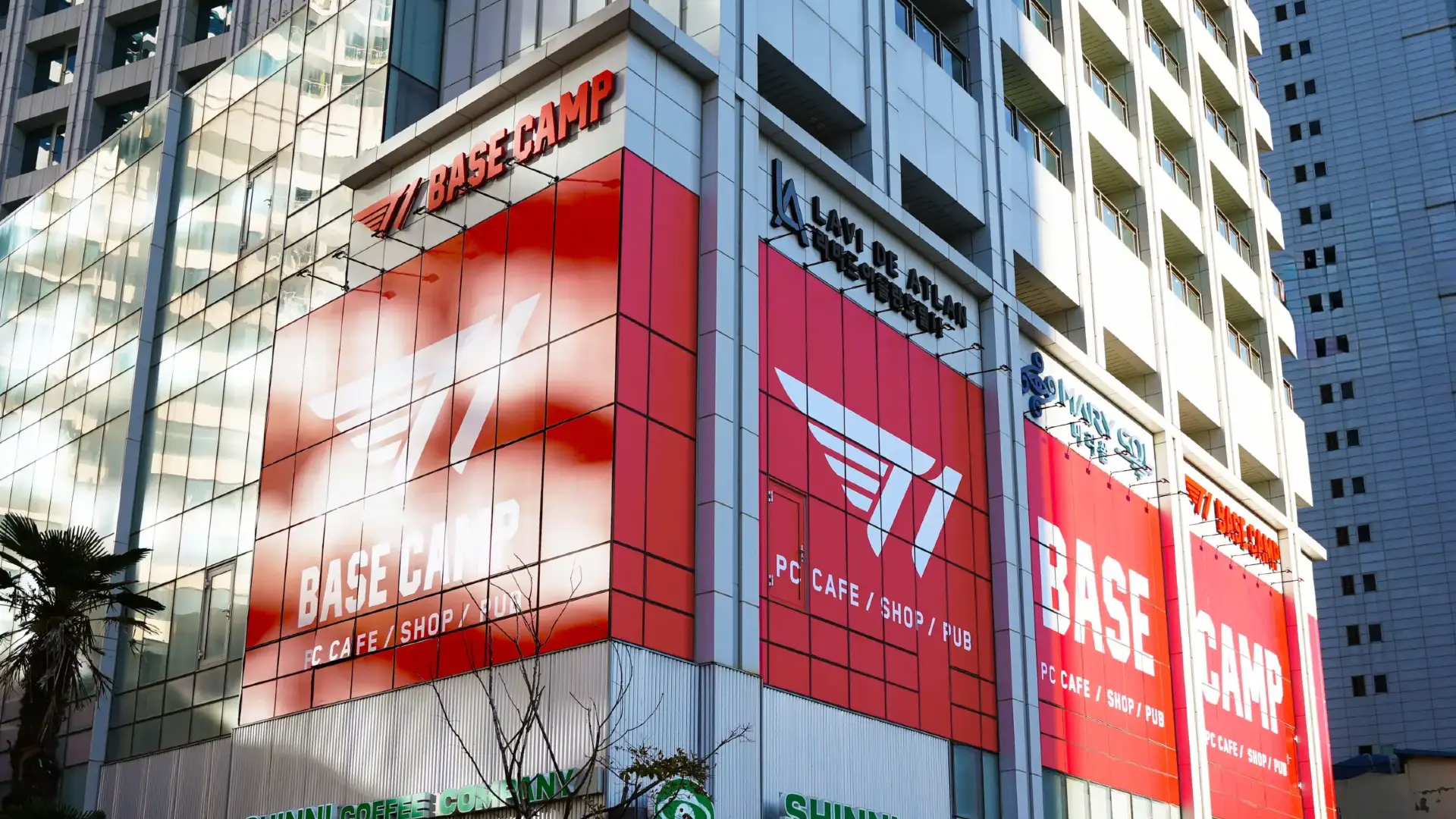
T1 Base Camp Busan. Credit: T1
Gangnam set to open in October
Loading...
Loading...
Three years after opening its Base Camp in Hongdae, T1 announced on August 14 the arrival of a third location, this time in the upscale Gangnam district. Twice the size of the original Hongdae site, this new venue is set to become the showcase for the T1 brand, a “flagship store” designed to embody the idea the club has behind its Base Camps.
During the second Home Ground of 2026 in mid-August, Sheep Esports had the opportunity to speak with Joe Marsh, CEO of T1, Tucker Roberts, a board member at the club; and Elliot Park, T1’s Director of the Fan Experience Department, who is notably in charge of the Base Camps. The latter discussed the Base Camps’ figures, the idea behind the Gangnam location, and the concept’s potential future internationally.
A PC bang that refuses to be just that
To understand what T1 is trying to build with its Base Camps, it is first necessary to understand how Elliot Park describes them: “We should start from the beginning. T1 Base Camp did not start off as, "Oh, T1's got to build a PC bang.” For the South Korean organization’s Director of the Fan Experience Department, “It's what we found as a forum to have an offline fan platform.”
“LoL Park's seats are less than 500, so it's not really big enough for T1”
The initial goal, based on his comments, was therefore to address the lack of venues where fans could watch a match in real conditions, or at least with a crowd and an atmosphere close to that of an arena. “Not all fans can really go to actual game matches, since there's a limited number of seats, and there are some people who don't live in Seoul, so it's far from their homes,” Elliot Park recalls. The idea was therefore to create an accessible “community hub” where fans could gather, support the team together, and enjoy a dedicated space.
T1 Base Camp Busan. Credit: T1
“Esports stemmed from Korean PC bang culture. So it was very natural for us to take the form of a PC bang as a base,” Elliot Park explains about the idea of making these meeting places PC bangs. However, the distinction is important to him, as T1 is trying to play on both sides of the concept: “We didn't really call it T1 Premium PC Bang or T1 Premium PC Lounge. We called it T1 Base Camp because what we wanted to build is not a PC bang — it's a base camp where T1 fans can come and feel our brand and meet other T1 fans and cheer together. So the PC bang is just a part of it and a form that we took at first.”
Other activations and interests have naturally been added to the concept for the South Korean club. This includes stores where fans can see, touch, and try merchandise, and the option to eat on-site, as well as spaces to watch T1 matches as mentioned above, whether in the LCK, LCK Challengers, or VCT Pacific. “Since you're filled with other T1 fans by your side, the atmosphere you have there when you're having a match is very, very energetic and very community-based,” he explains.
An economy driven by merchandise, not PCs
The Base Camp model is particularly intriguing because it reverses the usual assumptions surrounding a PC bang. Asked about the revenue split, Elliot Park is direct: “Around 50 to 60%, a little more than half, comes from merchandise.” The remainder is split roughly equally between “PC usage, the other half comes from [Food and Beverage].”
In addition to these figures, he discussed other numbers surrounding the Base Camps. According to him, “More than 50% of the visitors coming to T1 Base Camp are not actually Korean. More than 50% are foreigners.” Some of these international tourists, therefore, use their trip to South Korea as an opportunity to specifically play at T1’s PC bang, but many appear to primarily visit the venue and buy merchandise. It is a straightforward dynamic, as the on-site store and the ability to purchase directly at the venue allow international fans to bypass several issues. As Elliot Park explains, this is “because of the shipping fee and the tariffs they have to pay, and the customs they have to pay when they order from overseas. When they come to Korea, they like to just grab a lot of T1 merchandise. And also, we provide tax refunds, so they buy them in bulk.”
For Gangnam, the new Base Camp expected to open in early October, this dynamic should become even more pronounced. According to what he told Sheep Esports during the interview, the number of PC stations will remain comparable to Hongdae despite the site being twice as large. “We expect it to be a little similar, but then a little more of F&B and shop rather than PC café, because the number of PC seats is kind of similar to Hongdae,” he explained. This strategic decision is notably linked to a decision concerning T1’s current “HQ shop,” which is already located in the same district. The latter “is not big enough, so we're going to actually shut down the HQ shop and move it to the T1 Base Camp so that it can be our flagship store.” To further underline the importance of this new venue, the Base Camp will also partly house a Trophy Room “where [fans] can see the trophies and the history of our team.”
This logic of continuous improvement is also reflected in how the viewing experience has evolved from one Base Camp to the next. In Hongdae, watching a match was more of an improvised affair: "even though it's a good experience for our fans, they can't really have snacks while they're watching the game. And the structure itself is not really ideal for watching in a group, because there are pillars at the side, and the seating is not permanent seats. Every time we have a game, in an empty spot we lay out these kinds of plastic chairs," Elliot Park recalls.
"So what we wanted to do in Busan was to take something from generic sports, where they have pubs where you can watch the matches together—whether it be like NBA or like soccer or football," he explains. The result was a dedicated viewing space built around a big screen: "With that space, we put a big LED out there, and we provided F&B, including the drinks and alcoholic drinks."
Gangnam takes this evolution a step further: "Another upgrade from that to Gangnam is that we will be providing all-day dining. In Busan it was just simple snacks with the drinks, but in Gangnam we'll provide a full meal and some desserts, a little bit of café, and more variety of drinks that they can have, and a bigger space," Elliot Park says.
Why Gangnam?
After Hongdae, the original location, and Busan, designed to cover the southern part of the country, the choice of Gangnam for the third location follows a different logic. “Gangnam is always the prime area where the brands come in to show their presence,” Elliot Park explains. The district also offers several advantages, including one that is more logistical in nature: “There are two stations near our Gangnam location, and one of them is spread into the Gyeonggi-do province,” making the site more accessible than Hongdae for residents of the wider Seoul metropolitan area.
In addition to this first reason, the proximity to T1’s headquarters was also a key factor. “Our HQ is literally 10 minutes away by car from the Base Camp,” Elliot Park explains. The new site is also located right next to the restaurant regularly visited by the players: “It's right next door to the Haidilao that our players visit a lot. So whenever they go there, they could pop in randomly and meet the fans.”
Faker and the role of the players
Beyond its commercial function, the Base Camp plays a central strategic role in turning simple spectators or followers into genuine T1 fans. “When you come to T1 Base Camp and you like one of the pieces of merchandise—it could be a hat, it could be a badge—when you buy it, then maybe you can start feeling more attached to the team,” he explains. The collective atmosphere on match nights would play an equally important role: “Watching all those T1 fans cheering together for one game in sync, it moves the newbies a lot—to see how enthusiastic other fans are and if they like the atmosphere.”
While Lee “Faker” Sang-hyeok remains, by Elliot Park’s own admission, the unavoidable pillar of T1’s brand identity — “Faker is almost equivalent to T1 right now” — the Base Camps deliberately display content related to the organization’s other teams, particularly VALORANT, in order to broaden the potential fanbase: “So the people who come here would see, ‘Oh, T1 has a VALORANT team too?'“And they will be a little interested in the place too.” He also observes a positive snowball effect around the newest players on the League of Legends roster: “T1 fans who love Faker also start to love Peyz and love Doran. So I think there's a good snowballing effect.”
This dynamic also echoes the way Joe Marsh and Tucker Roberts view the future of the brand beyond Faker. The CEO confirms that the champion, under contract through 2029, remains central, while acknowledging that T1 has to prepare for any eventuality: “For us, it's play forever. But when you look at it realistically, you have to plan for every kind of event.” Tucker Roberts takes the analogy further: for him, the next generation will not rely on a single prodigy, but rather on “more of a collection, like the Avengers. They're going to be able to step up and each take a piece of… He's got the Infinity Gauntlet; they each are going to get one Infinity Stone.”
International expansion? Not sure
On the possibility of expanding the concept outside South Korea, the three interviewees broadly share the same outlook, but with nuances worth highlighting. Elliot Park confirms that projects exist in the long term, but T1 is currently prioritizing full control of the brand before venturing abroad: “When we go outside of Korea, it's not always easy to operate on our own. We might have to find local partners to operate.” The club therefore prefers to consolidate its model in the Korean market first: “So for the time being, we'll focus in Korea, where we can do everything ourselves, like 100% owned by T1. So quality control and brand control-wise, we are going to focus on Korea for now.”
Tucker Roberts, a board member at the South Korean club, is significantly more skeptical about the model’s ability to expand outside Asia. “If you're trying to convince somebody to drive over in LA or something to go play video games outside, that's just not really how Americans like to play their games,” he summarizes, while acknowledging a possible exception: “Maybe on a university campus (I could say there are exceptions to that, no)… Maybe in Taiwan, in China, and in certain locations.” Unsurprisingly, he considers Homegrounds much easier to export than Base Camps: “I think we have a lot more flexibility, because it's a one-time event, so it doesn't have the operating costs that a PC café model has.”