Alongside the
second T1 Homeground of 2026, held in Seoul on August 15,
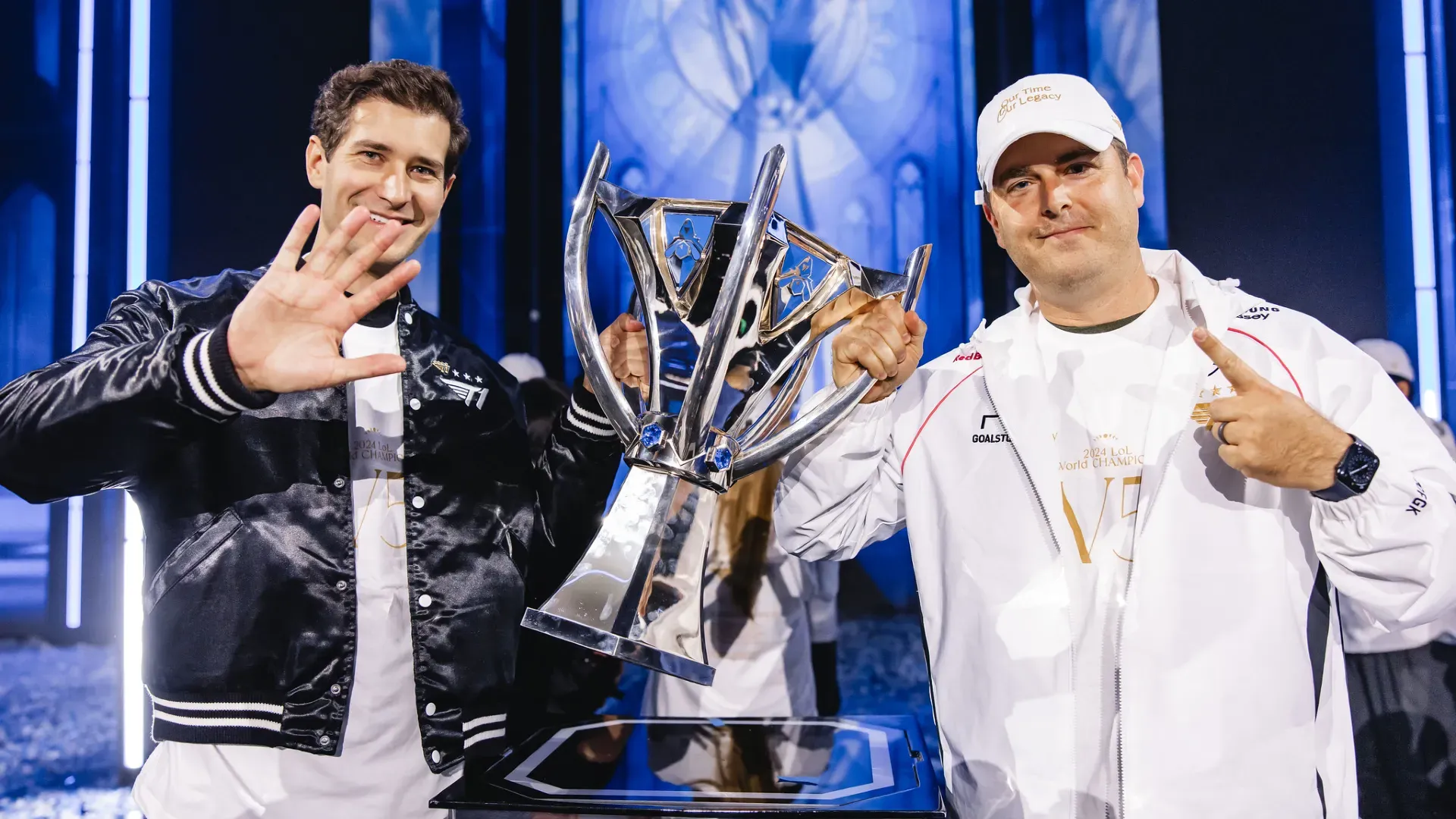
Sheep Esports had the opportunity to speak with several representatives of the most-watched organization in esports. It was a chance to learn more about the inner workings of the South Korean powerhouse while also discussing the club's current situation and future. In this first chapter, Joe Marsh, CEO, and Tucker Roberts, board member and Chief Innovation Officer at Comcast Spectacor, were featured.
They answered questions about recent investigations by
Sports Seoul, which reported numerous issues within
T1, including internal governance, player workload, Agency A, and more. Having remained silent on these matters until now, T1's executives shared their side of the story.
The context was tense. In July, after an early Mid-Season Invitational exit and a fourth-place finish at the Esports World Cup, funeral wreaths appeared outside T1's Gangnam headquarters, and fans
funded LED trucks to protest. Days later,
Sports Seoul published the first of five articles on T1's governance, its players' commercial workload, and the agency handling its sponsorships. T1 declined to confirm details at the time (“
We cannot confirm," the outlet reported) and did not provide a comment for its July 29 piece.
How T1 operates
Built on the foundations of SKT T1, the current organization, which has existed since 2019, is run through an alliance between two entities. On one side is SK Square, the investment holding company spun out of SK Telecom in 2021, which inherited the stake in the team SK Telecom had backed since 2004. On the other is Comcast Spectacor, the sports and entertainment arm of Comcast, the US group whose media holdings sit under NBCUniversal (NBC, Peacock, Universal, DreamWorks Animation), alongside Sky in Europe. Comcast Spectacor owns the Philadelphia Flyers in the National Hockey League and operates the group's arena in Philadelphia. Sports Seoul reports it holds 34.3% of T1 against SK Square's 53.13%, leaving roughly 12.6% elsewhere; Marsh refers to "a couple of other FIs, or financial investors."
2019 shareholding split. Credit: SK Telecom
“
We operate in a board setting, where you have a five-person board with members from the Comcast Spectacor side as well as the SK Square side and myself on the board,” the CEO explains, confirming that the organization's structure is indeed “
a partnership” between the two entities. According to information from
Sports Seoul, three SK Square representatives sit on the board, compared with two for the American shareholder.
On that split, Marsh says "all major decisions are decided by both of the main parents," while “the directions of the business, the operating side, is decided by myself and my team,” with the board notably overseeing budgets. Marsh has been with Comcast Spectacor for 21 years, starting as an intern in Philadelphia, and joined T1 as CEO seven years ago. "I grew up inside of Comcast Spectacor," he says. "I interned there, and I've never left."
“I serve at the board's pleasure”
In its successive articles, Sports Seoul has repeatedly discussed Joe Marsh's position, which he has held since the partnership between SK Square and Comcast Spectacor was established in 2019. The outlet revisited the expiration date of the CEO's term. In May 2026, an SK Telecom regulatory filing listed Marsh's term as running to March 30, 2029. Sports Seoul's own source addressed the gap directly: "The paperwork shows that, but Marsh's reappointment remains unfinalized and requires additional discussions between Comcast and shareholders."
In an article published on July 27, the outlet claimed that "T1 has effectively been left without a CEO since June 30." According to the report, since Joe Marsh's previous contract expired in October 2025, no new appointment to the CEO position had been formally finalized, and "the board has not reached a final decision on whether to renew Joe Marsh's term or appoint a successor." Marsh is therefore said to have worked under a series of short-term contracts until June 30, before the position entered a period of vacancy.
Marsh's answer disputes the framing but confirms much of the substance. "Yes, I'm still the CEO," he says, then immediately: "Again, I serve at the board's pleasure." He does not deny that his succession has been under discussion. "It's no secret I've been here seven years, and looking for the right off-ramp, when it's time for me to step aside has been a topic of discussion," he says. "And of course, there have been discussions with the board on that topic for a few years."
Various possibilities in the future
He goes further than Sports Seoul did on what those discussions might produce. "As we've grown and expanded, the demands of the role have changed," he says. "There might be two CEOs. Who knows? Maybe you divide it into the game teams and the business side." The board, in his account, is "always thinking about" the question: “How to make sure that their investment is protected and growing and thriving?”
Roberts confirms the position of Joe. "Yes, Joe is currently the CEO," he says. "If there is a new CEO at some point, it's a collaboration between us and SK to decide that. And so I don't see anything happening right now."
The
latest Sports Seoul article, published on August 25, after our interview, nevertheless casts doubt on this statement from the executive. The South Korean outlet returned to the matter, citing “
a source familiar with SK's internal affairs” and reporting that “
a board meeting was held this month and that in-depth discussions took place, including the appointment of the next CEO.”
While he says his future remains tied to that of the South Korean club, Marsh admits that he is thinking about what comes next. Primarily, he says, to focus on his family, noting that "it's important to find a better balance between family and work life." "When the board identifies the next person that they feel should be running the organization, I'll gladly take the step aside," he explains, before adding, "it's about the right timing to do it all, too. You can't just abruptly pick up and leave. You have to do it in a way that makes sense from a business perspective."
Internal tensions denied
Latent in Sports Seoul's articles, tensions appear to be affecting the two sides of T1's ownership. When asked how strategic decisions are balanced between both parties, Tucker Roberts, speaking for Comcast Spectacor, answers: "In terms of the support and the strategy, I couldn't ask for better partners than SK," "I think we have a great relationship with our partners at SK," he added, describing a "yin-yang relationship" in which Comcast Spectacor brings "a certain American viewpoint with a deep sports culture and a deep entrepreneurial culture" and SK Square a deeper understanding of "the inner workings of the Korean economy and the Korean fan bases."
He describes the process as genuinely two-way: "We might come in with one idea, and then they might come back with feedback, and then we might have feedback to their feedback. And through that process, you end up with a really solid plan that maybe neither side would have been able to come up with on their own."
Marsh describes no conflict either, saying T1 has "unwavering support from both of our parent companies." His account of the relationship is functional: his "goal is to make sure that the parent companies are happy with that growth, and so far they have been," he says, while emphasizing that the club is now "profitable" and a "self-sufficient business" that is "not looking for capital calls every other year."
To avoid burnout
In addition to questions surrounding internal governance, one of the grievances mentioned in the
July 23 and 26 articles was an alleged excessive workload for players. The first article cited a figure of 102 days spent on commercial activations, claiming that “
this amounts to roughly a third of the entire schedule.” In its second article, the South Korean outlet went into greater detail on the matter. “
Because the per-unit contract price is low, they have to secure more sponsors, and that burden inevitably falls on the players,” a source familiar with T1 said.
Tucker Roberts dismisses the claim. According to him, “
they got the number wrong,” he says, suggesting the outlet probably simply “
looked at the streaming schedule.” “
For any fans that are upset about that, I think they should know that that wouldn't make any sense. We would never do that,” Roberts explains. For the T1 board member, “
We would never, ever do anything sponsorship-related during a scrim block or a scrim review session or anything related to our actual game preparation,” adding that the club works on its players' schedules to avoid burnout.
He also rejects the premise that commercial work is the main threat to player welfare. "Myself, I've always advocated that if we don't guard players' time (and this isn't just for sponsorships, this goes to competitions and travel and everything) then players are going to burn out and they're going to retire young," he says. "The idea that esports players can't play into their 30s isn't really based in any medical science. If you look at Dota or Counter-Strike players, they'll play into their 30s. It's entirely based on burnout from how long our schedule is." His target there is the calendar itself: "If you look at the start of the LCK in January, and when Worlds ends, and KeSPA Cup and everything, and all of these incremental tournaments that we've added, there is no stoppage time."
“It’s not money first”
Joe Marsh is equally firm on the subject: “It’s not money first.” To defend the organization's approach, the CEO points to Homeground week, when he “canceled the streams […] because [he] wanted the players to focus on the competitive side,” while adding that making that choice “comes at a financial cost, because we have partnerships in there and we're not activating on those.” For Marsh, T1 is instead heading in the right direction, particularly over the past four years. “We’ve had a pretty robust competitive schedule as well as on the commercial side, and we've made it to Worlds finals four times and won it three,” he explains. In his view, the South Korean organization is therefore doing “a good job of balancing it all out.”
He describes commercial work as calendared far in advance rather than inserted into competitive weeks — "you might see the commercial come out, but that might have been shot months ago" — and says scheduling runs through the team's general manager, Becker, in consultation with the coaching staff. "It is a group effort across the org," he says. "It's not just the business side saying, 'Go here, go there.'" He puts the practice floor at "six-plus hours of scrims a day, their video review."
A mysterious agency close to Joe Marsh
The thread running through
Sports Seoul's reporting is the agency handling T1's sponsorship sales. Its
July 26 article referred to it only as "Agency A," described as "headquartered in the US" and, more importantly, as having "
ties to CEO Joe Marsh." Three days later,
the outlet named it as the Singapore branch of Creative Artists Agency (CAA), and set out the professional history between Marsh and Adrian Staiti, president of CAA Sports APAC. The relationship itself was not secret. T1
announced it publicly in May 2022, presenting CAA as its "exclusive Global Sales Agency.“
Sports Seoul clarified that “the key issue is not the two men's past connection or CAA Singapore as a company itself,” but rather what has drawn the industry's attention is “this rare exclusive-agency operating model in Korean sports, and its actual operational structure.” In its August 25 article, the outlet quoted a source close to SK who emphasized that “SK Square views the exclusive agency agreement and issues related to the CEO as serious matters.”
“They’re an extension of T1”
Joe Marsh confirmed the relationship between the two entities, explaining that T1 has “an exclusive relationship on the team side with CAA Sports, out of Singapore.” He also confirmed that he knows the agency's APAC president, Adrian Staiti, well. “I was his intern 21 years ago back in Philadelphia,” he explains. “He used to be part of Comcast Spectacor,” said T1 CEO.
Marsh, defends the exclusive aspect of this relationship, explaining that “if you look at successful partnership models across teams,” having a single voice that “sell[s] your product in the market enables you to control your message, control your pricing, and control your narrative,” which he considers more effective than having multiple entities that could potentially work against each other. The executive also confirms part of Sports Seoul's reporting, explaining that T1's partnership team “is to client-service those relationships that they work [on] with CAA.”
Tucker Roberts also defends the partnership. T1 is, he believes, “the first esports organization” to work with the agency, and their collaboration therefore appears to them as “a big achievement”. Joe Marsh adds that this arrangement is also unusual on CAA's side. "An agency like CAA Sports, they have some of the biggest properties in the world. They're selling F1, they're selling some of the biggest sports leagues in the world," he says. The value, in his account, is reach he could not buy otherwise: a network of salespeople meeting global brands who can say "we rep this game team out in South Korea," versus "having to fly around the world yourself as an org and trying to do that and going to different regions, it's so cost-prohibitive."
75% turnover? Yes, but…
Beyond this exclusivity, according to Sports Seoul, “there were also internal allegations that Company A had claimed as its own achievements even contracts it had not secured directly,” while T1 staff “have been instructed to focus on managing partner relationships instead.” Sports Seoul also claimed that this “internal dissatisfaction with this contract structure led to staff turnover” at T1, with “75% of the employees on T1’s Partnership Team having recently resigned.”
On this point, Joe Marsh confirmed to Sheep Esports that three of the four members of T1’s partnership team had left. In addition to these details, T1’s CEO also explained that T1 “have since recently hired a stronger team lead for the department with Lena Kim,” a new member who brings “significant experience in sales and servicing across Asia.” An important addition for him, “which was needed given our growth in recent years.” According to him, T1's commercial team also works on finding deals but focuses much more on the business side of the Basecamps, although CAA can also propose partnerships in that area.
He also points to personnel overlap as a reason the arrangement serves T1's interests, explaining that "one of the sales agents at CAA in Korea was a former T1 employee." Seijean Gahng, as he is known, "was on our partnerships team, and now he's selling for CAA across multiple properties." According to the CEO, that previous experience means he can "advocate internally, because he's worked [at T1], he's been part of the machine." Marsh adds that "now that they have their office in Korea, and we're also getting support from CAA teams both in China and the team in Singapore, it's been really great for us to help find unique partnerships that make sense for us as we go along the way."
T1 keeps the control
On the question of control, Marsh is also explicit. "We have the right to say yes or no to any part of the deals that they bring. So it's not just our agent goes out and signs a deal," he says. Packages are built jointly: "They go out, they cultivate a client, they bring my team in, they bring me in, we talk to them, we build bespoke packages," and "we're always the final say of go, no-go. It's not just done in a vacuum by our agency." He particularly addresses what he sees as a misconception in the articles: "There's a misconception that if you have a third party, they're on an island doing things themselves, but really, they're an extension of T1."
Roberts also denies that T1 is getting a bad deal from the relationship: “I can’t go into the percentages of it, but it’s fair to say it’s a very favorable deal to T1 in terms of the percentage that CAA takes.” “It’s a lower percentage than they’ve taken in other deals,” he adds. The Comcast Spectacor CIO also explains how the partnership came about, saying that “when we were first building our sponsorship revenue category, we wanted our sponsorship to have as high a margin as possible”.
“The benefit of working with a large agency is they handle everything, and so you find the right deal, you like the deal, you agree, and it’s in,” he concludes, once again emphasizing that T1 comes out ahead. Part of the benefit, he explains, is that T1 does not need a large internal team dedicated to finding new partners. “You get to keep a very high margin amount of the money, and you had to do almost no work,” he explains, before adding, “because [laughs] we wanted to make sure that that division was a highly profitable division, so that we could stymie the bleeding in those early years.”
For Roberts, CAA has therefore “just done an incredible job, and [we] don’t really see any reason why we would want to change our structure with them, because they’re best in class [at] what they do.”
Both interviews were conducted on the record and took place before Sports Seoul's August 25 article, which the executives were not able to respond to. The second part of this series will look at T1's business units and its route to profitability.