From
League of Legends’s Worlds to
VALORANT’s Champions or
Counter-Strike’s Majors, I have covered quite a lot of esports events during my time as a journalist. All of these major events are different, yet they also feel somehow similar, following the same established codes. But what I experienced
at the TPO (Teamfight Tactics Paris Open) truly felt unique. This might come as a surprise, since
TFT is a niche esports that does not belong to Tier 1. But size does not matter, and
TFT Opens could certainly teach a trick or two to some of the more mainstream scenes. With some time and continued investment, they might even set up new standards for more community-driven events.
For three days, I lived at the pace of “fast 9”, “reroll comps” and prismatic augments. If these elements don’t ring a bell, stay right where you are—you are the target audience for this report. Even though I do casually play TFT while on the toilets or riding the subway, I rarely watch competitive matches of it. Truth to be told, prior to the TPO, I had never attended a TFT tournament—which isn't surprising, as the scene doesn't organize many global events. But if all of them are as good as TPO, I might change my habits. But if they are all as good as the TPO, I might have to change my habits. I arrived at Porte de Versailles with few expectations, but I left with only great memories.
“TFT Opens are truly a beast of their own, and the vibe here is very different. We like to consider this closer to a “TFT-Con”. The competition is a big part of it, but it’s much more about a community celebration. For us, it talks about the two sides of TFT.” — Michael Sherman, Head of TFT Esports
What are TFT Opens?
Teamfightic Tactics was released in 2019 and now has a rather well-structured competitive circuit with four Majors on the schedule every year. First, three World Championships called Tactician’s Crowns are played, one per Set. Then, to celebrate the game and its players, TFT Opens events have been added since 2023 at the end of every season. Are these tournaments more prestigious than Worlds ? Hard to tell, but they are bigger for sure ! By nature, Open tournaments are open to everyone. In Paris, 768 players fought for the champion’s belt. To compare, for the last World Championship, “only” 40 players participated.
“For me, it is a very prestigious tournament that I would put on the same level as Worlds [...] The format is very complicated and isn't necessarily best suited for TFT. But if you want to hold an Open with that many players, you have to make harsh cuts.” — Emre "Double61" Demirtas, former TFT World Champion.
Credit: Colin Young-Wolff/Riot Games
With so many players and only three days to compete, the format is unforgiving… which also allows beautiful stories to be written. 512 players got cut after Day 1, and another 248 followed after Day 2. From the bracket to the badge pick-up, everyone is treated the same. Big names received no protection in the event of poor performances, while every single player was invited to strike “champion poses” upon arrival.
Since 768 players are on the starting line, you could totally choose your storyline to follow. Double61 was the obvious choice: the only French player who won a World Championship was seeking a new title on home soil. But while camping at the entrance on the first day, I met so many participants with different profiles. From Thailand to Rouen, from former World Champions to students looking for some thrill…everyone had their own story and objective. Some came to win it all, while others just wanted to face their idols and maybe survive the first day thanks to a lucky draw.
As a bonus, organizers even had the good idea to invite French content creators like Kamel "Kameto" Kebir (Karmine Corp), Corentin "Gotaga" Houssein (Gentle Mates), or Xavier “MisterMV” Dang (AEGIS) to compete. You could not only talk to them or take your best selfie, but you could also play against them in the tournament. And this is exactly what TFT Opens are about. They break down the wall between competitors and fans. During the weekend, Ge "Huanmie" Wuxin wasn't just the champion, he was one of us.
Why did theTPO felt so unique?
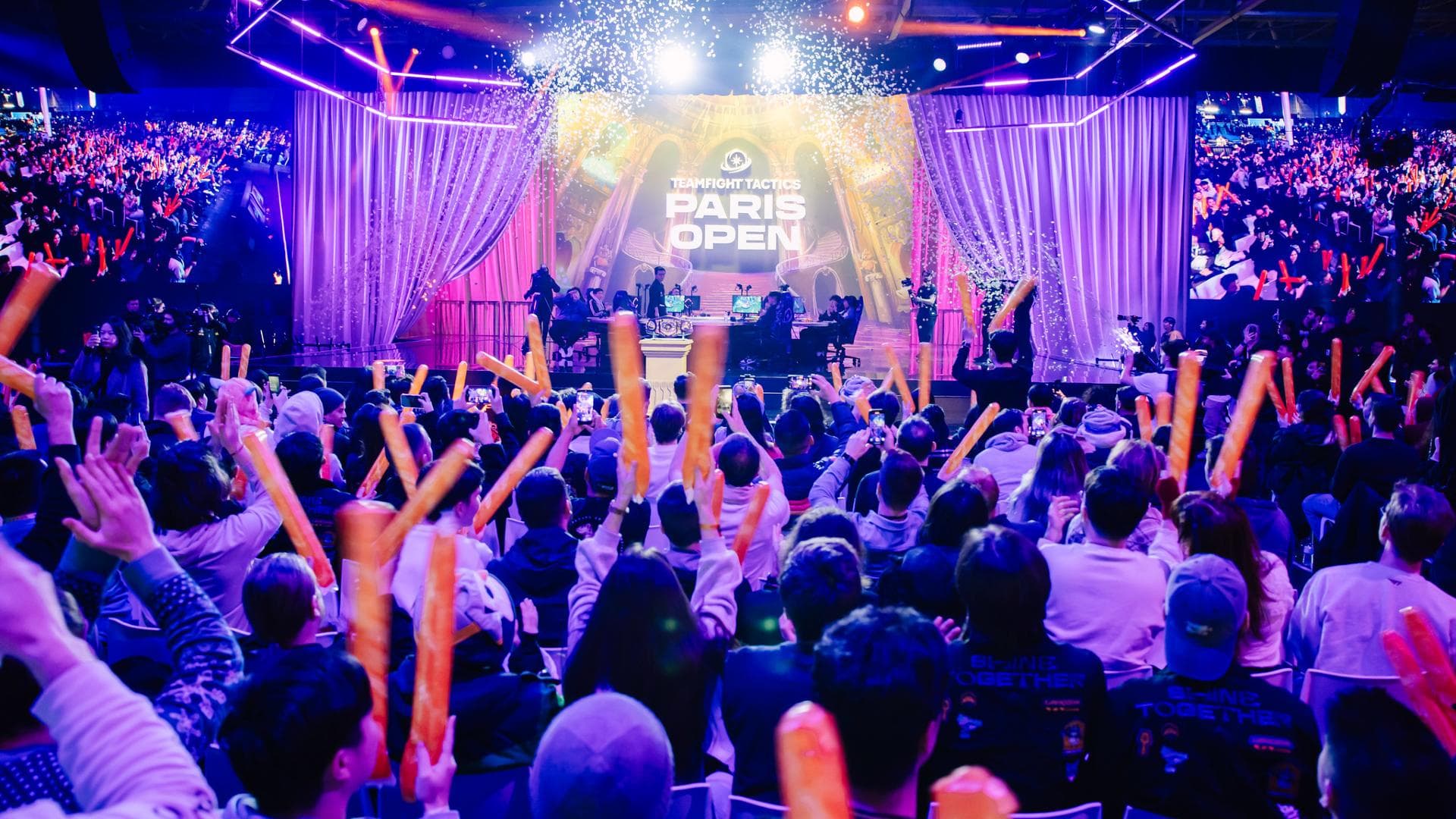
Many esports events take place in traditional arenas, but for the TFT Paris Open, players and spectators met in a massive exhibition hall. After entering the venue and passing through heavy black curtains, the magic began. Was it an esports event or Walt Disney World? Attendees were welcomed by cosplayers, mascots, and TFT scenery at every turn. In the back, the main stage was visible, but to get there, you had to weave through Artist Alley, food trucks, the official store, co-streamer setups, and a massive mural (2.4m x 6m) being live-painted by the artist Wanda. Rioters are known for their 'talking points,' and during interviews, one expression kept resurfacing: the event was a 'TFT-Con,' a convention in the same vein as Comic-Con, TwitchCon, or BlizzCon.
Credit: Colin Young-Wolff/Riot Games
One could argue that the TPO was as much a 'Riot Games-Con' as a TFT-Con, especially since the Riftbound arena was a primary attraction. Everyone wanted to register, but only 1,200 people managed to snag a session to learn this new card game—grabbing an Ahri promo card that might become a valuable collectible in the future. On the final day, a sealed tournament was even held. 2XKO also had a dedicated area with several stations; while its success was perhaps less obvious, it proved once more that Riot’s games feed each other to shine brighter together. It is also worth mentioning that famous French League of Legends figures like Laure Valée and Charles “Noi” Lapassat were involved.
It might sound counterintuitive, but having an esports event with so many other things to do, see or try felt refreshing. As a matter of fact, no matches from the main bracket were played on the big stage before the 4th round. Before that, you just had showmatches, quizzes, or funny activations. The hardcore esports fans looking for peak performances did not got forgotten and had more than 200 screens to watch simultaneously.
Personally, I decided to follow the journey of Lucía “Ey3z” Martín-Pintado and Mario “Lumarpin” Juez, a Spanish couple coming from Madrid. Who said that TFT was a solo game? They met through the game and supported each other throughout the event. Luckily for them, they were seeded in the same lobby, yet they finished remarkably close:111th and 115th. Out of 768 players, these are quite impressive results. Since they were not competing on Day 3, they were free to enjoy the finals, hunt for Riftbound cards, and visit Paris.
“Making it to the second day was already a success. I had so many elite players in my lobby—even World Champions like Huanmie and Dishsoap were eliminated early. Ey3z also had PasDeBol in her lobby, who is an incredible EMEA player. We are very happy with our performance. I was told only five Spanish players made it to the Top 128, and we were two of them.” — Lumarpin, Spanish player.
Still some room for improvements
On-site, the TFT Paris Open felt fantastic. Compared to League of Legends Worlds or VALORANT Champions, I truly enjoyed the freedom of moving around and speaking to just about anyone. Even the top-tier players were accessible; you didn’t have to go through a rigorous PR process to get an interview right in the middle of the venue. As the name suggests, TFT Opens strive to be as inclusive as possible.
However, while the organizers are doing an impressive job, I still have some observations to share. First, the TPO was not accessible to everyone. Rank restrictions are understandable, especially since the 768 spots filled up instantly. But there is an elephant in the room: the entry fee. General players had to pay $399 to compete. Even though Masters ($299) and Challengers ($199) received discounts, these prices clash with the 'Open' philosophy.
When you factor in transportation and accommodation, attending the event in Paris was by no means cheap. The financial burden was a major talking point; most European players I spoke with admitted they had skipped the Macau and Las Vegas Opens simply because they couldn't afford them.
The champion belt on display at TFT Paris Open 2025. Credit: Jianhua Chen/Riot Games
“I still don’t know if I want to become a professional TFT player; making a life out of it seems pretty hard. Right now I am above Master so I could get a discount and since I live in Rouen, it did not cost me that much to come. But if I did not get the Master discount, I am not sure thatI would have come here.” — Antoine, 25 years old.
For spectators, prices were more affordable. Early birds paid $100 for three days, while others paid $130, with various premium offers also available. On that note, and to be totally transparent, every player did receive a personalized jacket and enjoyed a unique experience. Still, I wasn’t a fan of the pricing model—particularly the rank-based pricing.
My second comment would be easily understood by fans coming from the FGC (Fighting Game Community. While I was interviewing Michael Sherman, EVO (Evolution Championship Series) events were mentioned as a source of inspiration. This influence was clearly visible at the TPO, with a series of side tournaments running alongside the main competition, such as 4v4, Mastermind, Carousel of Chaos, and Tocker’s Trials.
The idea was great for keeping the venue alive as stations began to get emptied following the large cuts in the main bracket. However, only competitors were allowed to register for these side events. It would have been much more impactful if the audience could have joined the fun—especially for an event that aims to be community-driven. Of course, it may cause new challenges in the organization, but I really do think it's worth trying.
“We take a lot of inspiration from the fighting game scene. I think anyone can come and compete at EVO, but very few are coming with the idea of winning it. Most of them are like, “OK, I'm gonna drop 0-2, and it’s gonna be my fun time". So we wanted to make sure with TPO that people would spend a great weekend, bringing the same energy. It’s great to see people running into each other, meeting in person people that they have met online.” — Michael Sherman
Next stop in Vegas
The TPO was an eye-opening experience for me, and most attendees would likely agree that the event was a resounding success. I am now very curious to see how the TFT Open circuit will evolve. The next stop has already been announced: a return to Las Vegas in 2026, three years after the inaugural edition.
I naturally tried to investigate whether a potential three-year rotation was in the works—or if a return to Paris was already on the horizon—but Riot officials remained tight-lipped. However, given the pivotal role the French community plays for esports organizers and the undeniable success of this Paris Open, I expect a global TFT event to return to French soil sooner rather than later.
Header Photo Credit: Shannon Cottrell/Riot Games