On December 11, on the sidelines of the
Counter-Strike 2 Major in Budapest, ZOWIE hosted members of the press
as part of a Media Tour to present its products and outline its strategic vision as a market leader in esports equipment designed for professional FPS players.
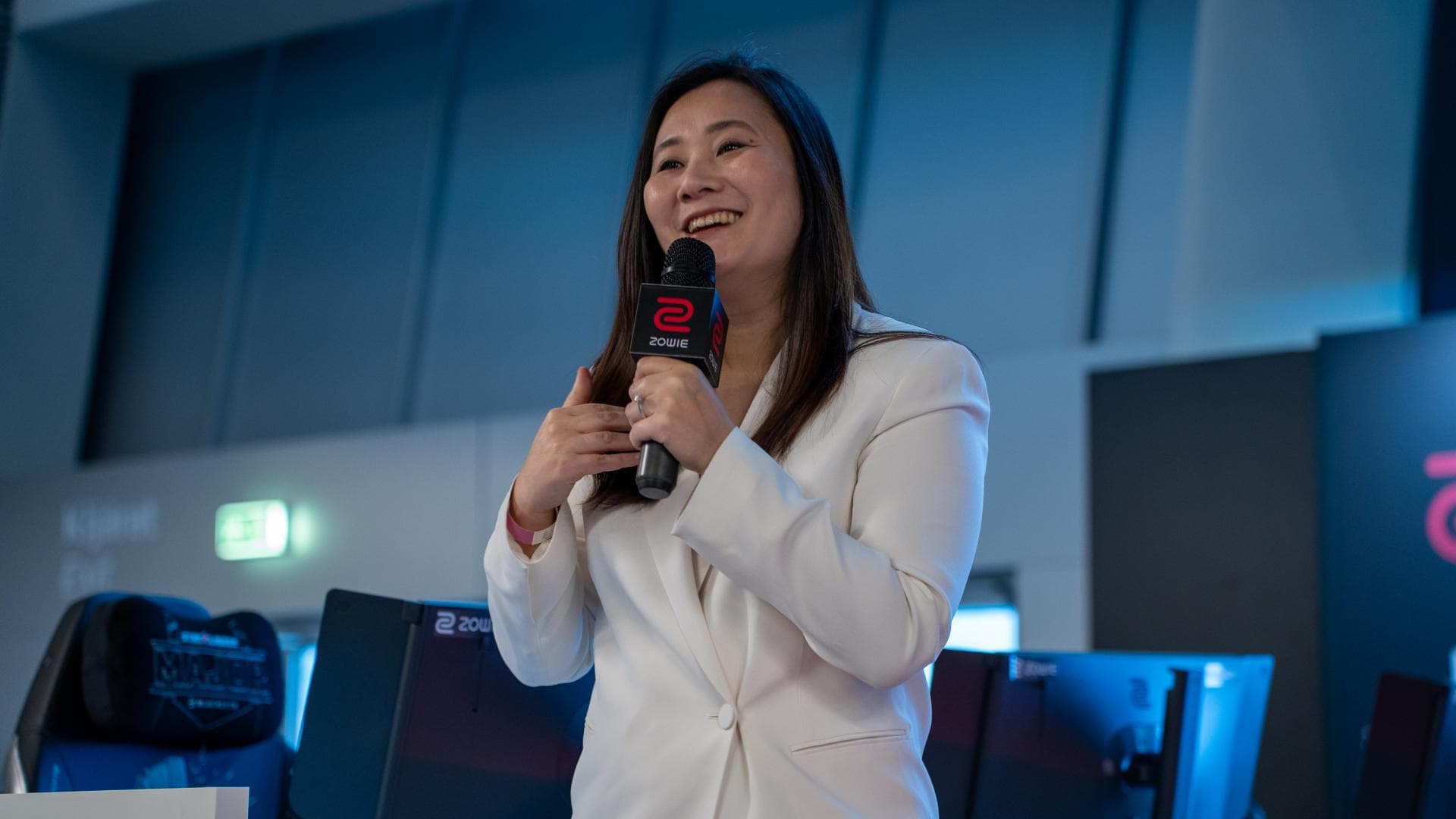
Sheep Esports had the opportunity to speak with Celsa Wu, Head of ZOWIE’s esports business at BenQ Europe B.V., and to discuss the brand’s working methods with professional players, as well as its successful positioning within the market.
How does the technology of the new monitors help boost the performance of each part of the device?
Celsa Wu: “We try to offer smoother performance and better stability, especially in terms of motion clarity. For example, when players are jumping around, it becomes difficult to aim precisely. That’s why we use a 600 Hz panel, combined with our own features like DyAc. When we ask different pros why they think DyAc is good or not, sometimes they can’t really explain why it’s better, but they say they feel better and see more clearly when it’s turned on. For most pros, or even general users, it’s very hard to explain why it’s better, but after playing for a while, you can see the difference. That’s why we always try to offer something that can help players in-game. One of the biggest challenges is that you keep moving while still needing to aim. Whether it’s a dark scenario or a different color scenario, we try to help players identify enemies more easily. The same panel can come from different competitors, which is why we emphasize what our own features can bring. We also believe in a positive loop: if pro players get used to playing on our monitors at home, they will expect to see the same monitors at tournaments. This strengthens our presence in tournaments.
How do you work with professionals on a day-to-day basis to improve products?
Celsa Wu: For us, the biggest benefit of sponsoring top teams is that we can ask them to test our products and develop them together, while collecting feedback more easily. We also value feedback from different tiers of pros. For example, players who didn’t make it to major stage two or three might join our stage one testing sessions. Some teams aren’t even present here, so we schedule visits to their bootcamps or invite them to our facilities. The reason we want to broaden the pool is that every player’s preferences, behavior, and habits are very different. We try to collect as many different scenarios as possible so we can identify common needs and directions that suit most professional players.
How deep is your collaboration with pro players? How often do you visit bootcamps to get feedback?
Celsa Wu: Among the top 10 or 15 teams, around 7 or 8 are often based in Serbia during the offseason. So we go there quite often, because in one place we can test products and collect feedback from many top teams at once. We talk to them almost daily. Sometimes they tell us, “This unit is worn out, can you send a new one?” Other times, after a tournament, they might say they need some adjustments and ask us to come over or invite us to test things together. Most pros already have their gear adjusted to their personal preferences by the time they bring it to the stage or to practice.
Can you give a specific example of an improvement made after feedback from pro players?
Hsin Yang, Lab Researcher at BenQ Europe B.V: One example comes from mouse design. For instance, scroll wheels can have different actuation forces. We might decide to test three or four different options and ask pros which one they prefer. This kind of design change is very small, but even small adjustments can impact in-game performance. We rely on pros to validate whether these details are actually beneficial. It’s hard to name a specific player, but these changes always come from collective feedback.
Can you share insights on upcoming products?
Celsa Wu: We’re planning to launch a new mouse next year, and we’re also exploring new product categories. You’ll see more next year, hopefully around the next Major.
Do you plan to target other esports titles than FPS, such as League of Legends?
Celsa Wu: Our monitors are already used in League of Legends tournaments, since Riot uses our monitors for those events. It’s not our main focus yet, but we don’t prevent organizers or publishers from using our products for non-FPS titles. Right now, our focus remains FPS games like CS, VALORANT, and Fortnite.
Do teams ask you to work with them on League of Legends as well?
Celsa Wu: Actually, I received an inquiry last week because Riot uses our monitors in the LEC, so they need to purchase them for their League of Legends teams. We’re currently discussing pricing. As more people see our monitors being used across different titles, they naturally come to us for support.
Is working with League of Legends pros different from working with FPS pros?
Celsa Wu: Sometimes it can be different, but we haven’t put a lot of effort into that yet. We still receive feedback, and if players need help adjusting settings to better suit the game, we help them.
What will be the next major improvement in monitor technology in the coming years?
Celsa Wu: I often ask our product development team this question. If our products are already very good, what’s next? Most of us would say color. Many users complain that outside of gaming—like after playing CS for hours—the colors feel too saturated. We’re trying to find the right balance: keeping strong in-game benefits while making colors comfortable for everyday use. So color is definitely an area we want to improve further.
Do you plan to open up to a wider audience beyond esports?
Celsa Wu: It’s like Nike launching sneakers—they don’t say they’re for teenagers. They say they’re for Michael Jordan, for top-tier athletes. That’s also our approach. Of course, casual players are welcome to use our products, but when it comes to development and communication, our goal is always to meet the highest competitive standards.
How did ZOWIE establish itself as a reference in the FPS scene despite strong competition?
Celsa Wu: We don’t make PCs, which is both a strength and a limitation. It forces us to focus entirely on displays. We interviewed many users across different segments to understand what they needed. We found a missing demand and identified FPS as the most competitive and most-watched genre. That’s why we’ve focused on FPS for around 15 years. Over time, through experiments, tournaments, and pro player feedback, we realized we needed to stay extremely focused on this niche and the competitive scene. That focus is what established us in FPS.”
Header Photo Credit: ZOWIE