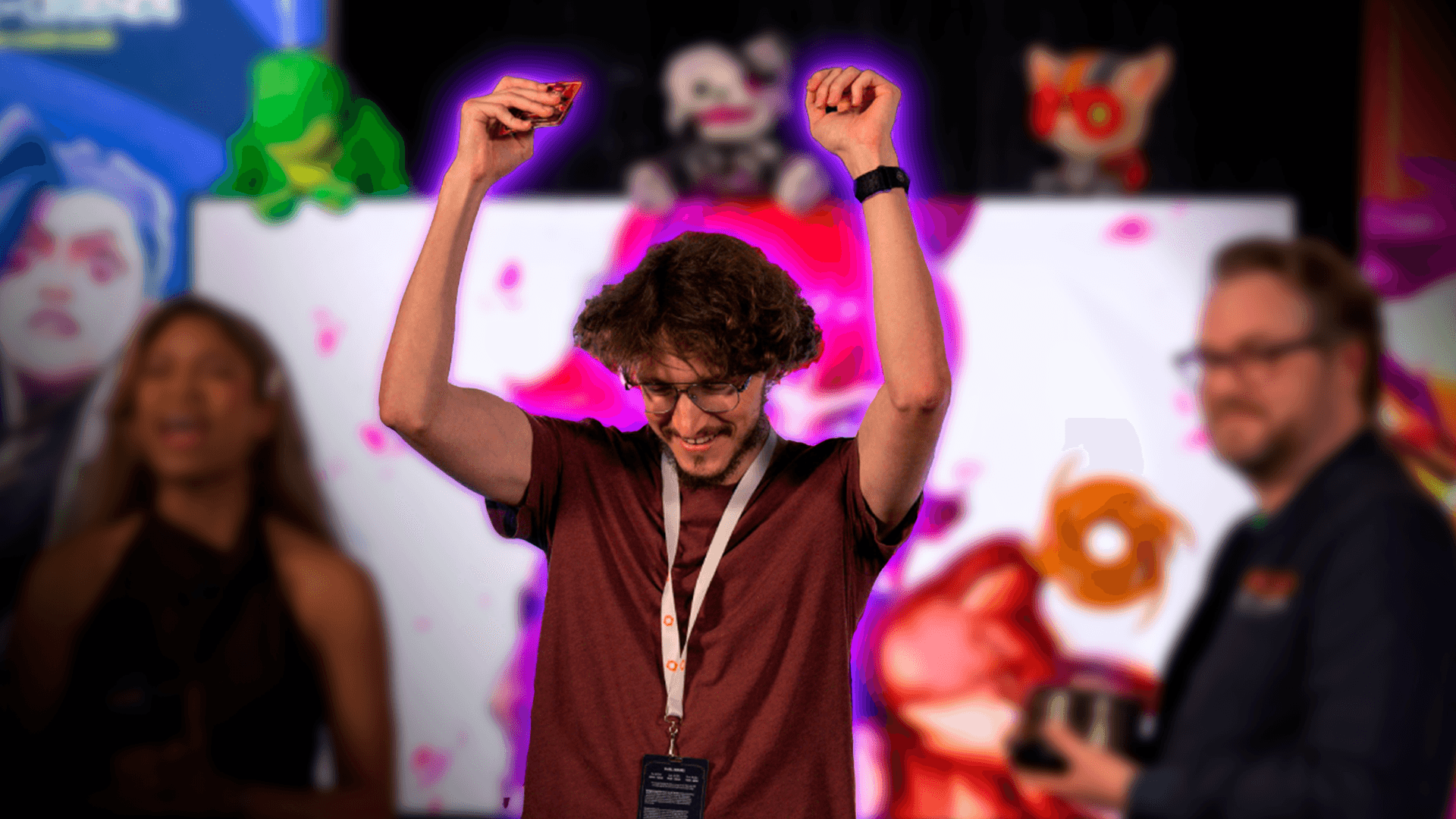
Riftbound Atlanta's RQ winner Prismaticismism: "I didn't believe that I had won even after he shook my hand"
Riftbound Regional Qualifier's winner in Atlanta talks about his path to pro and why this TCG is worth picking up in an interview.
00
Share
Prismaticismism wins Riftbound Regional Qualifier in Atlanta. Image via Riot Games
"I would've been a toddler where my grandfather, I was visiting his house and then he sat me on his lap and went on the computer"
Loading...
Loading...
A rare run of consistency turned into a breakthrough in Atlanta, where Kyle “Prismaticismism” Belaiche, who had reached top 8 in all four Riftbound Regional Qualifiers in 2026, finally claimed the trophy just days ago.
In an interview with Sheep Esports, Prismaticismism shared how surreal it felt to finally win a Riftbound Regional Qualifier. After years of looking thourgh multiple competitive games, Prismaticismism shared what ultimately made Riftbound the first title he’s fully committed to and what kind of mental discipline is required to succeed at the highest level of play.
Thank you Prismaticismism for joining me for this interview, and congratulations for winning Atlanta. You've reached the milestone after chasing it for quite a while now and you told me that it doesn't feel real quite yet. Can you maybe elaborate a bit on that?
Kyle “Prismaticismism” Belaiche: Yeah, and it's partly just after so many attempts, I was starting to worry that I'd be choking every time I got close. So even in the last game, I didn't believe that I had won even after he shook my hand. It was like, did I really win? Because that game lasted so long and every single turn was on the edge. And even watching myself, I think I've changed a lot over the past few months. It's almost like I don't recognize myself as much as I used to in a way. So it's kind of who I am now, trying to get comfortable with that.
Knowing you from our interview in Bologna and from what others have told me about you, it doesn't feel, from an outsider perspective, that you changed that much. Can you share how did Riftbound impact your life as a pro player and then personally?
Prismaticismism: Yeah. And I spent a long time after Heroes of the Storm, I was a pro player of HotS back from 2016 to 2018. And then after that game, the competitive scene got shut down. Then I spent a long time just trying to find another game that I could compete in because that's really what I wanted to do, that's what I dreamed of doing as a kid. There were games that I dabbled in, some games were smaller that I found some success in, some games I got pretty good at but wasn't enjoying enough to really want to stick to. And then Riftbound has really been the first game that I've enjoyed a lot to want to stick to and really put time into it. And then I've also been able to get good enough at it to compete.
So how did winning in Atlanta change your life? I mean, it's been only two days, but how did it have an impact on your life?
Prismaticismism: I feel a lot more, I guess self-assured, confident in myself that I can actually do it compared to previously where it was just always falling short. And yeah, I think I can just bring that confidence forward now. Hopefully I don't get too cocky going into future events because I was already feeling it a little bit where I'd show up day one thinking “who are these people? They're just randoms. I should be able to beat them easily” and disrespecting opponents. But that's one thing that I've learned as well is no matter who it is, you have to respect your opponent. They can always surprise you. Even if they make a stupid misplay at some point in the game, they can still make good plays later on and you can't just get overconfident and play into whatever they're doing.
You were a pro player before on Heroes of the Storm and you were a pro player now, regional qualifier winner on Riftbound. How did games, in general, influenced your life and your career choice?
Prismaticismism: So it all started, I would've been a toddler, with my grandfather, I was visiting his house and then he sat me on his lap and went on the computer and then he showed me just some really simple games on his computer — and then I just fell in love with it immediately. And then that became an obsession for me growing up. Then I found out about esports and started watching esports around when StarCraft II came out. So then I would spend a lot of time watching StarCraft II content, tournaments, and then started following League of Legends as well, and then a lot of other esports over the years.
That eventually got me into Heroes of the Storm where I competed, and after that I don't remember the timeline of it, but there were a lot of games. There was Legends of Runeterra — that was a big one where I streamed and there were some online tournaments, smaller grassroots tournaments before the Riot official competitive scene started up, kind of similar to Riftbound before all the regionals started, before the game officially released. And then I competed in those, but then I fell off of the game before or by the time the official Riot events started up.
That would've been cool if I actually competed in those because then I would've competed against Alan in that game too, but just never happened. And all of the servers were segregated between regions, so I never got to actually play against Alanzq (Mateusz Jasiński) in LOR, which is unfortunate. That would've been really cool. And then yeah, there were a bunch of other games, like Supervive, that was last year, and I can't even remember most of them, but there were quite a few that I got good in, but could never stick to.
Did TCGs’ rise in popularity have any weight in your decision of starting playing Riftbound or any influence, like the amount of people talking about cards games, playing card games?
Prismaticismism: No, I don't think so at all, really. I don't think I've ever chosen games based on how big they are. It's really been more about how much I enjoy them. And I remembered one other one, Eternal Return was one that I actually spent a decent amount of time competing in. But for TCGs this is actually the first one I've competed in at all in terms of in-person ones.
I've played Hearthstone, MTG, LOR, Flesh and Blood, but all of those basically all online. Never really in person. I went to some small MTG events, a couple of small Flesh and Blood events, but never anything as big as a regional. So when I went to SCGCon in Vegas last November, that was actually the first big event I ever went to. I just threw myself in the deep end, basically. And then I managed to top eight that. And then Houston was a week or two after that. And then it's just getting used to that entire experience: the long day grind, the room full of people, all of the noise trying to focus compared to being onlinejust in my room, being able to be as comfortable as I can be.
Now, considering all that, what makes Riftbound a good game, not just as a card game, but like a good game to play?
Prismaticismism: It has a lot of depth. I think that you get unique board states pretty quickly in the game. The first couple turns play out pretty similarly, but then there's always something that comes up where with a... Because you're never going to have the perfect draw, something's going to change, something's going to shift at some point in the mid-game, and then you're going to be in a new situation you're going to have to figure your way out of.
And with the way the point system and the battlefields work, it means that games don't really snowball out of control and there's a lot of dynamics and positioning where it can turn into a really grindy game. And I think every single match in the top eight, every single game in the top eight that I played turned into that where it was really scrappy trying to fight for positioning, trying to fight for the right point tempo. And there's a lot of depth in that.
That means there's a lot of room for mistakes to happen and also for very smart plays to happen. And it gives a lot of room for the better player to win where compared to a lot of other card games where the win percentage of the best players may be 55 or 60% against the field. I think that in Riftbound already it's a lot higher and I think it could easily stay that way. And people will catch up and it'll balance out a bit, but I think the better players will still have a very significant advantage against the rest of the field.
And added to that as well with the rune system means that there aren't any non-games where you miss out on resources the way that MTG has it. So every single game you're going to have useful cards that you're drawing every turn. You're never going to just burn out on cards and you're never just going to have a non-game that basically over on turn one.
Moving forward, there is going to be a bigger and bigger cards’ pool for players to pick from when they build their own deck. So considering what you just said, and the more cards coming out, how do you think that is going to influence the game?
Prismaticismism: It's hard to say. I think it will add to the number of cards that you need to play around. And I think in Set 1 (Origins), and even in Set 2 (Spiritforged) to some extent, you could have a perfect idea of what range of possibilities your opponent could have and to be able to play around them. Whereas in Set 3(Unleashed) and then going forward, I don't know how many sets there are going to be before they start rotating them out, but there's going to be a larger and larger pool of cards that you're going to have to think about and consider.
Because with the way the game works you could just add one of any card to your deck, some situational card that if it comes up, then it's going to be amazing and still useful in other situations. And when there's only maybe like three or four of them, you could play around all of them, but if there's going to be 10 to 20 of them in total, you're never going to be able to play around them. You're going to have to really hedge your bets and play around whatever's most likely. And then the number of legends is going to keep increasing as well, which Is going to be interesting because I think they've done a good job of creating legends that have different play styles, even with the same color pairing, where there is a decent amount of overlap between the cards. But the way that the deck plays out and the way they have to play against it is very different.
It's going to add a lot to the amount of practice that's needed to really stay up to date with all of the different decks and how you play against them, all of the matchups. So I think that's going to make the game more skill intensive for whoever can be best prepared going into it, or whoever can adapt on the fly, at least has an understanding of what they're playing against and then can figure out a plan when they get into the match.
Now going back to what I said before about misplays, in our interview in Bologna, you told me about a round 12 misplay that tilted you a bit. And then something similar happened in Atlanta, but something that got me curious is at the end of the final. While everyone was cheering, you were just focused on your cards and your opponent. So can you talk me through what you were thinking, what you discussed with Koko Lopez?
Prismaticismism: Yeah, so it was partly was the very last turn where he was talking about the decision not to hard bargain the Ride the Wind and then the Falling Star that he had. And then partly was a turn earlier in the game where he had a Noxus Hopeful on each battlefield and then he had a hidden Tide turner with one of them. And then I misplayed that turn where he had two runes open and I made a play that ended up giving him an extra card draw from an extra combat win by fighting into the Tide Turner battlefield. I didn't expect him to switch the Tide Turner with his Kai’Sa was the issue with my play, but I was having an issue against Spinning Axe where the play I made, if he doesn't switch with his Kai’Sa then I'm going to be able to be safe attacking into either the Tide Turner that gets flipped or if he plays the Spinning Axe, then I can fight the other battlefield.
But specifically when he switched with the Kai’Sa, that put me in an awkward spot because then I still couldn't play around Spinning Axe and ended up in the same position. So if I had expected that, then I would've gone to the other battlefield and just accepted that if Spinning Axe gets played, I have to play Rebuke, which isn't a great trade for me, but then at least I move forward with the game and then he gets denied the card draw and that would've made the game a lot easier for me the rest of the time.
But it really, the best time to discuss and think about those things is right afterwards while the memory is fresh because if you wait long enough, then it all starts to deteriorate and you can't build the perfect timeline and you can't remember exactly what was in your hand.
So if you want to go back and analyze it, I mean, fortunately there's the VOD of it for the Finals match, so that can still be analyzed from there, but for any match that isn't being recorded, you have to really construct that memory and that timeline as soon as possible so that you can then go back and look at it and think about it afterwards.
I think it was Nick "LS" De Cesare that you met in Las Vegas that said on a stream.. I think he said you're a genius, in the broad sense, so not just in the Riftbound community, so do you remember-
Prismaticismism: yeah, that's very high praise. Yeah, I played against him, I believe it was round three at Las Vegas. I think I don't actually remember what I did to count the cards in my deck. I was playing miracle, so part of that deck is writing down all the cards that you recycle because then when you get back to them, you have perfect information about the order of your deck. So that's the reason that I would count the cards in my deck.
He was saying he was asking to try to calculate the odds I had certain cards in my hand, but that wasn't actually what I was thinking about in that case. But for counting the cards in my deck, I don't actually remember. It's possible I picked up my deck and just counted it and he might not have noticed, that is possible. But the other possibility is it was something that I did sometimes is count all the cards in my trash because I lay them out in rows of five and then count all my cards in hand and then calculate the cards left in my deck that way.
Or another thing that I do, which is a lot more effort, but did it sometimes is when I get close to the second cycle, I count so that I start counting all of the cards that I've seen so far to try to remember which cards are unknown left in my deck. That's mostly for Nocturne, but it's something that I did sometimes so that my opponent wouldn't know that I was counting the cards in my deck so they wouldn't know when I'm getting to the second cycle. So I deny information like that.
Is that something that only you can do or this is something that every Riftbound player can learn to do? And if so, what would you give us a suggestion to someone that would like to, let’s say, count cards like you?
Prismaticismism: Yeah, you could do it, it would just take practice. The easiest thing to do is just pick up your deck and count it, you're allowed to do that. Obviously, I was always a little bit hesitant to do it because it could look suspicious or I would just tell my opponent, “I'm going to pick up my deck and count it” just so I put my hand down. I'm not trying to move cards around or anything, do anything cheating, but with practice you can [count cards].
I think laying out the cards in trash in rows of five helps out with if you just want to count all the cards that have left your deck. But without a deck like miracle existing, it's not too useful of a skill. It still takes energy and mental focus to do that when you could be using that energy to think about possibilities in your opponent's hand or think about the next turns, so plan those out.
So it was a lot more useful with a miracle deck, but definitely could be learned, but there's a lot of other skills that you could learn and play around as well that would be probably more useful for your energy and time.
What would you say are three skills that every Riftbound player should improve on?
Prismaticismism: Three skills. I think the first one is trying to read what's in your opponent's hand, what they don't have in hand based on what they did with their turn, how many runes they held up, play around that. I think the easiest way to lose is just playing into what your opponent has held up on your turn, just walking into that and giving them maximum value. And added to that, also knowing what they want their turn to look like, their next turn to look like, and trying to make that as difficult as possible, where a lot of decks just want to spend their whole turn developing a unit and then you can take some risk by putting the unit on a battlefield, but even if they have the card that punishes you, then it's also denying them what their ideal turn would be.
And then I think deck building is very important, like understanding the core cards of your deck, but then also constructing a sideboard with a lot of useful cards. I think a lot of people end up... I mean, even me before I refine a sideboard I end up with a lot of unnecessary cards where there's no plan for when they come in or come get sideboarded out or way too many cards for a certain matchup. Often when I build a sideboard, I just throw in five cards that are just anti-Aurora cards and then it's like, there isn't that much Aurora, you don't need that many cards for it. But then also with every deck, there's always a few slots that you have for single cards that are more situational, but very, very high value in those situations. And then figuring out what those cards are and how easily you can fit them into the deck.
You've praised Riftbound and it’s community, what is something that according to you, Riftbound needs to improve? On any level.
Prismaticismism: I think it'd be nice if the rounds could be a bit shorter, like the overtime, every round is quite high. I think part of that is the inexperience of the judges. I mean, I don't want to be flaming judges or anything, but I think that the majority of the overtime every round at this point is from judge calls. But I think that's also partly on players where players are trying to get advantages through judge calls or through slow play.
I think that before the round starts, the pairings, the software for pairings could be improved because every single round, it's 2,000 players are all trying to refresh the same webpage and it takes minutes and that adds up. If it's going to be eight rounds, that's an extra half hour or so that just gets added to the day just for people waiting to figure out what their pairing is before they can go sit down.
Anything else that could be improved? Anything game-wise?
Prismaticismism: Hopefully Aurora gets banned. I think it's quite unhealthy. I think especially with Elder Dragon, it's going to be very unhealthy going forward.
When Elder Dragon got spoilered, I made a tweet saying Aurora stocks going down, because I was expecting it would never survive going into Set 3. I thought it would just get banned in the ban list. That was four weeks ago at this point, like month ago, but then it didn't. So that was surprising.
But I think that card, even if somehow Elder Dragon isn't enough to push it into an unhealthy territory, there's going to be a card in this set for and every set after this, there's going to be... Either they can't ever make a unit that costs more than eight or nine with any strong effect, or they're going to make those and then Aurora's just going to keep getting better and better.
Freelance writer exploring the gaming, esports, and entertainment industries. Growing up playing games and discovering new music shaped my curiosity for the stories behind them. Today, I turn that cur...