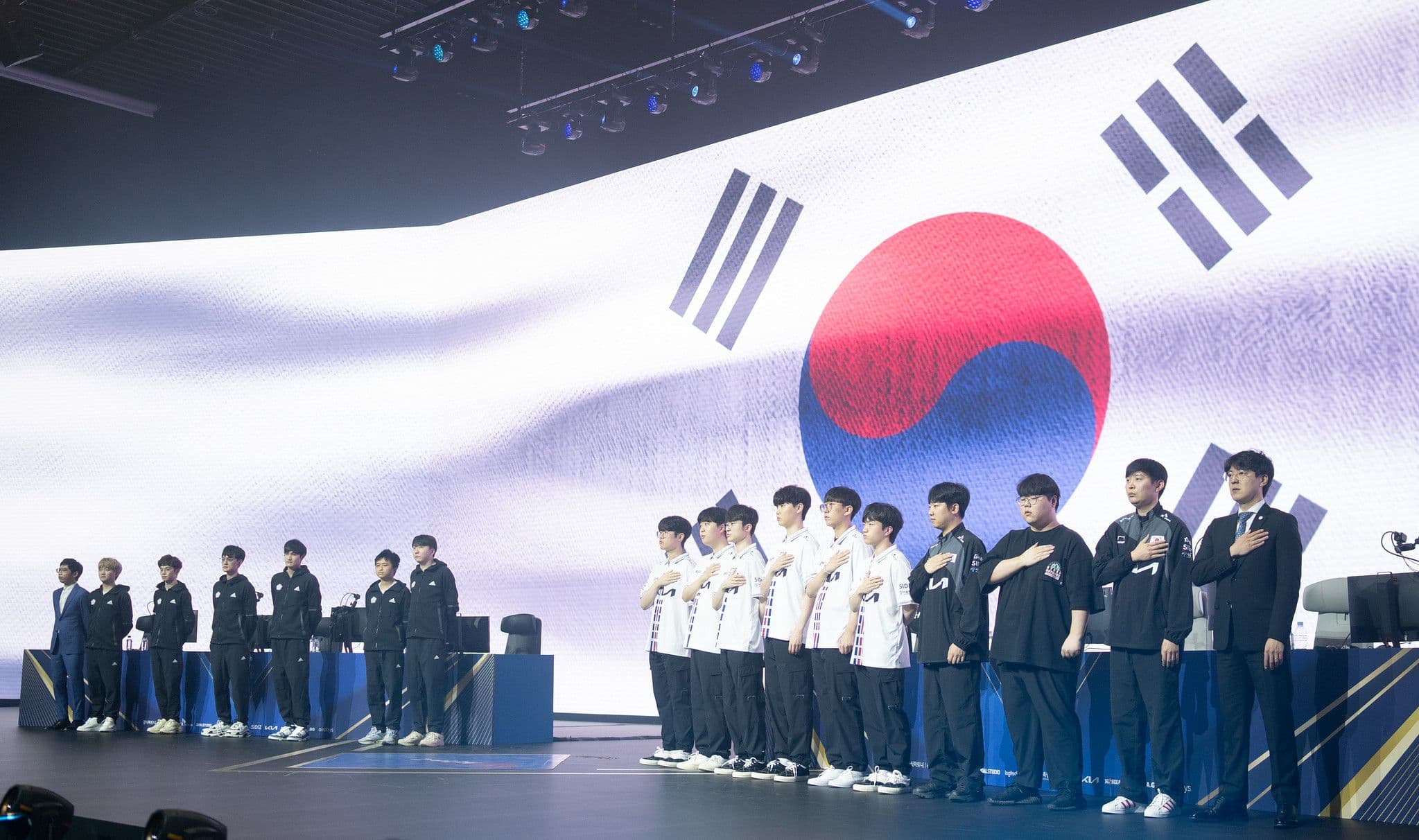
South Korea’s
League of Legends roster for the 2026 Asian Games is finally here and it seems ready to win a second consecutive title.
Korea eSports Association (KeSPA) revealed on Monday, 18th six players selected as candidates for South Korea’s final
LoL team. The roster read as follows:
- Choi "Zeus" Woo-je (Hanwha Life Esports)
- Kim "Canyon" Geon-bu (Gen.G)
- Kim "Zeka" Geon-woo (Hanwha Life Esports) and Lee "Faker" Sang-hyeok (T1)
- Lee "Gumayusi" Min-hyeong (Hanwha Life Esports)
- Ryu "Keria" Min-seok (T1)
The announcement immediately ignited a debate across the LoL Esports community, both for the names included and the missing ones.
The Asian Games are expected to take place in September 2026 in Aichi-Nagoya, Japan, with esports returning as an official medal event after its debut in 2023.
Same roster at the ENC?
The roster still needs final approval from the Korean Olympic Committee, but unless unexpected issues appear, these players will officially represent the country next year. Worth noting that,
according to KeSPA’s website, “
players registered with the Association and guardians, coaches, and heads of affiliated teams of players who participated in the national team selection competition” have time until May 28th to file objections regarding the selection.
But this announcement matters for more than just the Asian Games, as it’s assumed the same roster will also compete in the upcoming Esports Nation Cup, although nothing has been officially confirmed. Recent tensions between KeSPA and ENC organizers over scheduling and player participation have placed a spotlight on the chosen players even before their reveal. South Korea remains one of the strongest League of Legends regions in the world, so every roster decision quickly becomes a major topic no matter the instance.
Recurring and missing names
Of course, the first name on everyone’s mouth is Faker’s. The T1 star is now set to compete at the Asian Games for the third consecutive time, making him the first esports player to achieve that milestone. He previously represented South Korea at the 2018 Jakarta-Palembang Asian Games, albeit there esports was only a demonstration event, and again at the 2023 Hangzhou Asian Games, where Korea won the gold medal in League, and the whole roster received exemption for the mandatory military service as a result.
But at the same time, some familiar names from 2023 did not make the roster this year.
Park "Ruler" Jae-hyuk, who played alongside Faker in both previous tournaments, was not included in the candidate list. Still in the AD Carry role,
Park "Viper" Do-hyeon, once again excellent this season with Bilibili Gaming,
had expressed to Inven a few days ago
his desire to represent South Korea.
Jeong "Chovy" Ji-hoon also missed selection, reportedly because of ongoing hip problems
according to Naver Esports.Guma-Keria duo is back
Similarly, the jungle role continues to rotate between generations. Previous national teams featured Go "Score" Dong-bin, Han "Peanut" Wang-ho, and Seo "Kanavi" Jin-hyeok as junglers. This time, Canyon earns the spot, adding another experienced player to a roster already filled with star power and international success.
The supposed roster also reunites Gumayusi and Keria, one of the most successful botlane duos in recent LoL Esports’ history. The two players spent years together on T1 and helped the organization win three consecutive World Championships from 2023 to 2025, and were separated when Gumayusi left T1 for HLE during free agency last year. Now, less than a year later, they are back together again, wearing South Korea’s national colors.
With their reunion, only Mun "Oner" Hyeon-jun is missing from the lineup to complete the previous T1 roster known as ZOFGK.
Criteria used to choose South Korea’s League team for Asian Games
South Korea is undoubtedly the region holding the most talented and awarded players of LoL Esports’ ecosystem, therefore picking only six players to represent the country was bound to lead to questions from fans. And while the 2026 candidates all hold World Championship titles, some fans are pointing out that there might have been other players who fit the criteria better.
In its website, beyond the first review criteria, KeSPA lists some general criteria, “common to all position”, and then specific ones for jungle, support, and ADC positions. KDA, Champion pool, DPM and DMG% are among the common criteria. The jungler was also decided on the probability of contributing to first blood and Jungle CS, while jungle adjacency was listed as a specific criterion for supports.
Here is the full list of criteria used to choose South Korea’s League of Legends team for Asian Games, according to KeSPA and as translated by DeepL:
- League and Tournament Metrics
- Converted points based on performance in each regional regular season
- Converted points based on performance in each World Championship
- Converted points based on performance in each KeSPA CUP
- Individual Award Metrics
- Converted points based on selection to the All-Pro Team (1st–3rd) in each regional regular season
- Converted points for Player of the Game (POG) selections by regional regular league season
- Secondary Evaluation Metrics
- Common to All Positions
- KDA
- Solo Kills (Average)
- KP (Kill Participation Rate)
- Number of Champions Used
- DMG% (Team Damage Contribution)
- DPM (Damage Per Minute)
- DPG (Damage Per Gold)
- GDPM (Gold Difference Per Minute vs. Opposing Laner)
- 14CSD (Creep Score Difference Before 14 Minutes)
- 14DPG (Damage Per Gold After 14 Minutes)
- TeamGold (Team Gold Share After 14 Minutes)
- TeamDMG (Team damage percentage after 14 minutes)
- Vision Score
- Jungler
- First Blood Contribution Rate
- Enemy Jungle Invasion Duration
- Counter-Jungle CS
- Support
- ADC, Support