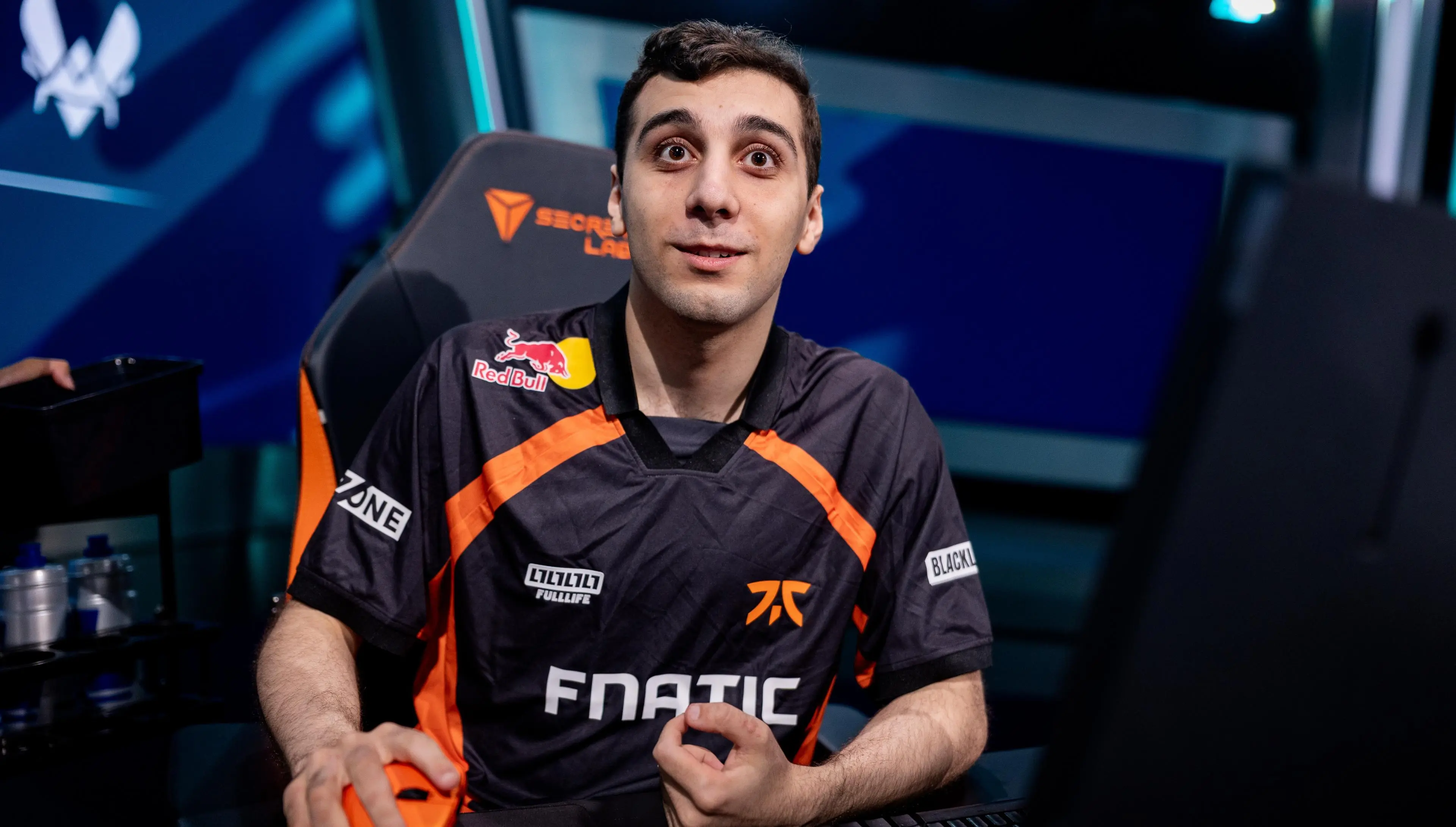
On August 10, 2026, a symbolic milestone in European solo queue finally fell.
midlaner Vladimiros "
" Kourtidis became the first player in EUW history to break the 5,000 LP barrier, now sitting more than 800 LP ahead of the second-ranked player on the ladder.
This climb has been built on 1,916 games since the start of the 2026 season, with a 54% win rate (1,044 wins, 872 losses). His ascent has been almost industrial in pace: +460 LP in the last week alone, and +1,070 LP over the past 30 days. Vladi has constructed this run on a relatively wide champion pool. Ryze, Jayce, Azir, Cassiopeia and Twisted Fate feature among his most frequent picks since January.
A comfort pool that doesn’t match his LEC identity
The unsettling part? That list barely overlaps with what he has played for Fnatic in the LEC this year. In team competition, he has leaned into Taliyah, Azir, Orianna, Aurora and Anivia, champions that fit Fnatic’s system or the pro meta, but not necessarily his solo queue comfort zone.
The contrast is stark. In the LEC, Vladi is posting one of the lowest win rates among midlaners this year, alongside some of the worst individual stats at his role in Summer: lowest gold per minute and CS per minute, ninth in gold diff at 15 (−404) and CS diff at 15 (−9.1), a KDA around 2.2, and last place in damage per minute.
One theory often floated for a struggling Fnatic side is to restructure their system more explicitly around their midlaner, who visibly looks more comfortable controlling games on comfort picks. In that environment, you might see the Vladi who dominated the ladder a year and a half ago. For now, though, that remains speculation.
Why LP records are falling faster than ever?
Vladi’s 5,000 LP is not an isolated case. Since the start of the 2026 season, LP ceilings on EUW have exploded to levels never seen before, with multiple factors driving this inflation.
Riot reworked the ranked system in 2026. Base LP volatility has been increased, with gains and losses now able to reach around ±30 LP per game, compared to a much tighter range previously. The goal is to compress the ladder more quickly around each player’s true skill level. A loss-mitigation system was also introduced: when matchmaking puts a player in a clearly disadvantaged team on paper, the LP loss is reduced. Priority roles (autofill) also benefit from a bonus system, which can double LP gains on wins with strong individual performance and remove LP loss on defeats with decent play. Combined with a high-volume grind like Vladi’s, these mechanics allow for much faster climbs than in past seasons.
Another major change: the return of duo queue in Master, Grandmaster and Challenger since patch 26.01 in January 2026, several years after it was banned at the highest ranks. Climbing as a duo, with the communication advantage that brings, mechanically makes it easier to gain LP at the top of the ladder—even if Riot has added MMR-based safeguards to limit the most obvious abuses. Finally, the removal of promotion series since 2023 has smoothed progression: players no longer need to chain multiple consecutive wins to cross a tier, which further accelerates the climb for those in form.
The result is a cascade of records this year. The previous EUW benchmark dates back to February 2025, when G2 jungler Rudy "
" Semaan hit 2,263 LP,
overtaking the prior record held by Muhammed "" Kocak. At the time, Vladi, then with Karmine Corp, was within 200 LP of first place. A year and a half later, he has more than doubled that old record.
Solo queue dominance doesn’t always translate to pro success
This gap between solo queue performance and LEC results is not new for Fnatic. The most emblematic case remains Carl Felix "MagiFelix" Boström, now a cult figure for veterans of the scene: he had five accounts in the top 10 of the EUW solo queue ladder in 2018, and in 2020, he climbed Challenger on five different accounts, one for each role, simultaneously, a feat never matched since. He became a legend of EU solo queue, but that potential never fully translated into a top-tier professional career.
Because Magifelix’s career afterwards perfectly illustrates that paradox. Despite his status as a ladder prodigy, the Swede never managed to establish himself durably on the professional scene. After stints with Fnatic Rising and a brief promotion to the LEC lineup at the end of 2019—for a single appearance that ended in defeat—he moved through secondary and academy structures,
including Astralis from 2021 and later Misfits Premier, without ever securing a starting role in a top-tier league. He has since retired from competitive play. His path, several years before Vladi, already raised the question: what else is needed, beyond raw talent displayed in solo queue, to truly succeed at the highest level of pro play?