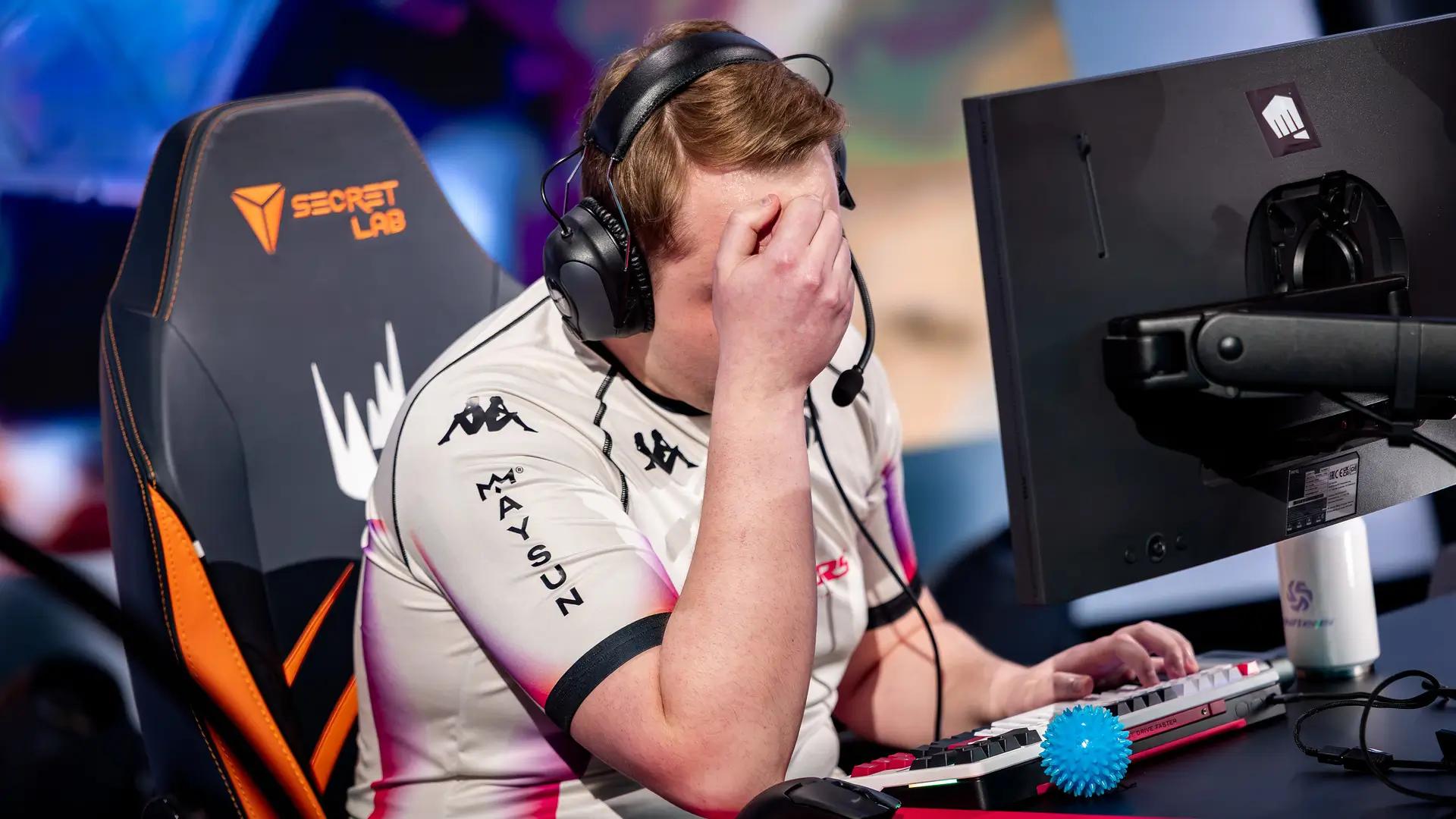
Pressure begins to mount as
sit at 0–3, having had the least amount of games taken out of any
LEC team. With six matches to go, the Swiss organization finds itself in a dire spot, with dwindling hope as the days go by. With an upcoming match against
next week, before the
team’s appearance at the Évry-Courcouronnes roadtrip the following week, a massive turnaround is needed if the team wishes to keep itself alive in the 2026 LEC Spring Season.
In an exclusive interview,
Sheep Esports sat down with the team’s support,
, to discuss the reasons behind Shifters’ struggles, as well as the effect on his and his teammates’ mental health.
Why do you think is still struggling to close out games? It was already an issue in the LEC Versus.
Adrian "Trymbi" Trybus: “We have a hard time gluing together. We struggle to be the same page. I feel like everyone has his own idea, and it turns out we’re not really in sync with what we want to do. A couple of seconds can mean a lost fight, a lost objective, a lost situation—and that kind of snowballs.
We tend to drop the ball quite a bit, and when we do that, it’s not easy to bounce back. Especially in this meta where gold comes in quickly and, if the enemy team gets a bit of cash, then your lead can disappear in an instant. It’s just harder to maintain the control that you normally have.
I think we’re just not on the same page in a lot of aspects, which hurts us.
After reaching Worlds last year and having a strong run in Brazil, you made it back to the LEC—something you were hoping for yourself. Now, with the team struggling and a real risk of missing playoffs again, how has this contrast affected you mentally—both as a player and on a personal level?
Trymbi: It for sure feels bad. These struggles are the ones that’ll make you wonder whether you’re good enough just to be playing in the LEC, right? I feel like I am, but the results and the way we play are just not good enough. These results aren’t really indicating that. So at the end of the day, you start questioning whether you even deserve to be here, if this is your place.
It saddens me to think that way. I usually try not to overthink it, but coming from a difficult split in the LEC Versus, and now having a Spring Split that looks even worse results-wise, it’s not a good sign.
As someone with more experience, I should be leading the team more, but I’m definitely struggling with that. That’s something I’m trying to focus on, even if it can make other parts of my game worse, which hurts me.
The most important thing is to show up every day and try to win games. No matter what our score is, you have to keep going. Even if it’s 0–3 and it looks like we’re almost out, it doesn’t mean we’re completely out. I just need to keep putting in the work and prove that I’m still worth a spot in the LEC.
To what extent do you think these struggles come from team-wide issues versus individual shortcomings? I can imagine you must feel a bit powerless at times as well—you can’t control everything.
Trymbi: It definitely feels like that sometimes. At the end of the day, I don’t think you can be a good team if one person controls everything that’s going on. It can feel easier when everything is smooth and one person is making all the calls, but the best teams usually have four or five players who can understand each situation and find solutions on their own.
I wouldn’t say we have players who can’t do that. It’s more that when we have a plan, we don’t stick to it enough. I also don’t think I always have the best calls, which doesn’t help.
We have a lot of different opinions, and that makes things harder. The plan can get messy when we’re not on the same page, and that’s what happens sometimes on stage. It definitely hurts us, especially in games where we’re ahead.
After your first match, gave an interview to RFT.GG in which he was very negative, expressing a sense of hopelessness. Do you think this kind of sentiment can snowball within the team and contribute to a negative spiral?
Trymbi: Of course, as a teammate, you don’t want to hear someone say they feel powerless or that there’s no hope. I didn’t fully read the interview, so I hope that’s not exactly what was said. But we did talk about things as a team after that week and tried to address those feelings.
I think that conversation gave some hope to everyone, at least to keep pushing. That was our goal for the following week. Even with how things went, I still think we can take some positives—for example, taking a game off Vitality, and even today, where we were ahead in game one. In an ideal world, we win that game and maybe push the series to three, which would have helped.
At the end of the day, though, it comes down to results. I just hope none of my teammates start thinking the split is already over. Even for myself—I'm not the most positive person either—but we can’t have that mindset. If we do, we might as well stop playing and just give up, and that’s not something I want.
I just hope we can go up from here. It doesn’t look ideal, but there’s not much else we can do right now except refocus and go again for the next matches.
Do you think there’s value for pro players in learning to control or even sometimes hide their emotions, especially if showing them can affect team morale or performance?
Trymbi: I definitely agree. It’s important to control emotions. For me, I don’t have an easy time controlling emotions, especially the negative ones. I’m not the kind of person who can always stay completely composed—of course it depends on the situation and everything.
But from my experience and years of playing, I don’t think someone who comes into esports early, like at 20 or even 30, has fully figured out how to control emotions completely. I feel like most people, even later in life, still struggle with that.
And I think it’s unrealistic to expect players, especially esports players, to have perfect emotional control. The environment is different, and the way people come into esports now compared to before is also different. So I don’t expect that level of control from everyone. It’s actually quite rare when it happens, and usually it comes from difficult experiences earlier in life.
You learn it over time on your own. I just think, as a human being, it’s hard to learn. I wish there was more knowledge around it. I definitely think our performance coach,
Mew (Théo Ponzoni), is helping in that regard—at least for me, it’s been helpful. I’m not sure how others feel, but I would assume they feel the same.
There’s been some discussion around Shifters’ long-term results, with your head coach often receiving criticism. Would you say there are deeper systemic issues in the team?
Trymbi: If our structures were perfect, we’d probably be winning. I don’t think it’s only on the players to win. So there’s definitely some merit to that idea.
I’ve personally worked with
Striker (Yanis Kella) for the past two splits. We had our controversial talks, we had our struggles, which I think is normal for a coach and a new player to experience. We went through them, and I think we both learned a lot—how to work with each other, how to make things work.
When it comes to the criticism I’ve seen about Striker from multiple people, I personally don’t really see it. And even if something like that did happen, I feel like he has learned a lot from it.
At the end of the day, it hasn’t been an easy time. Of course, when you’re losing, it’s hard to say you’re enjoying working together. I refuse to say that—that’s just not true. But I think we’ve been managing our problems quite well. We do have moments where we argue or try to push things to the limit to find the best solution, but I feel like it’s handled in a mostly professional way. And even when it isn’t, we come back the next day and try to do the best work we can.”