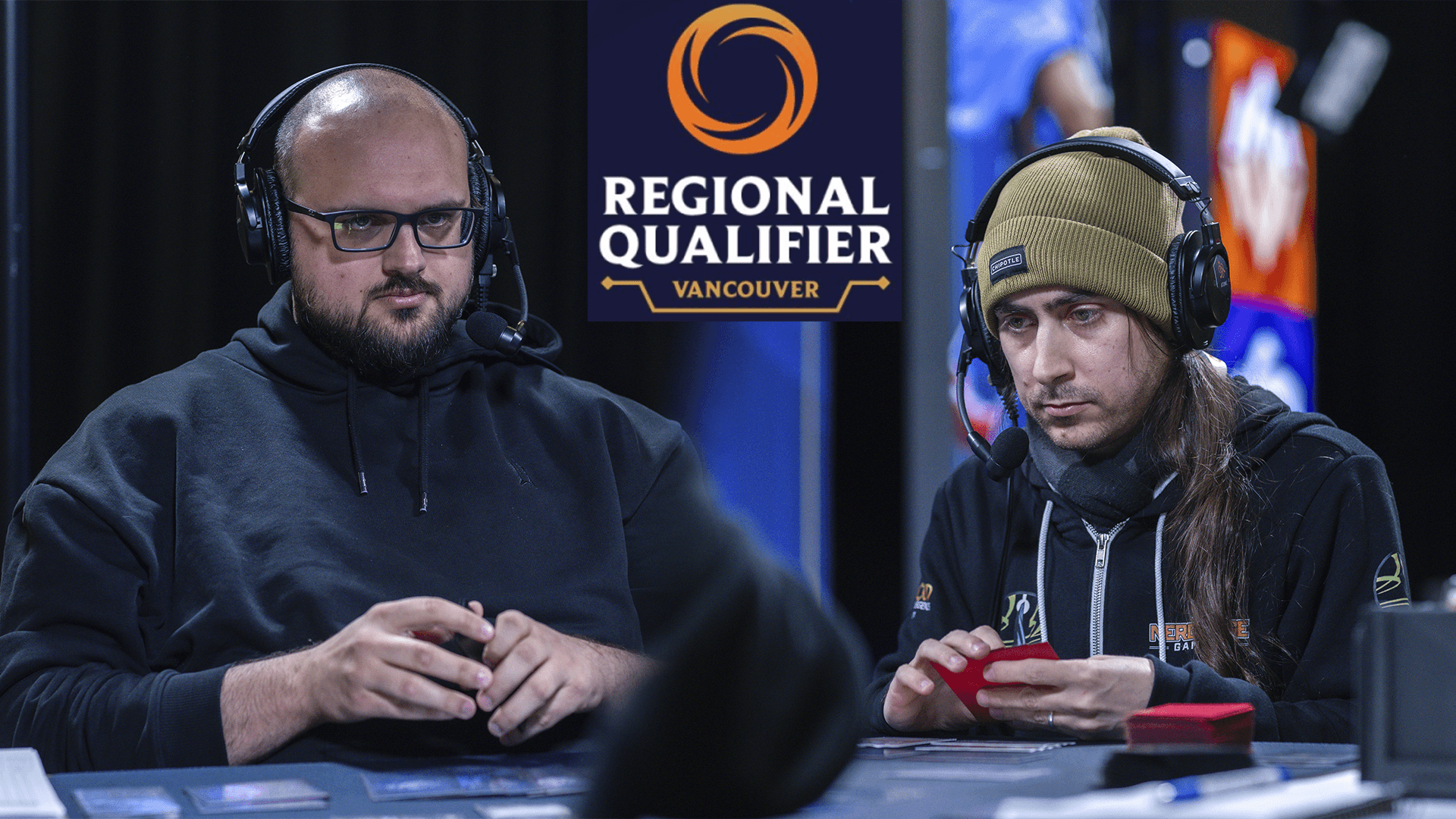
For the first time in Riftbound competitive play history, we have a repeat Regional Qualifier champion. It was always likely to happen eventually, but it came in a Final where both players already had RQ titles of their own.
At the Vancouver Regional Qualifier,
Mateusz “Alanzq” Jasiński — winner of RQ Bologna — lifted the trophy after a very close final against
Sam “Samdsherman” Sherman, the RQ Las Vegas champion.
In an interview with Cecilia of Sheep Esports, both finalists talk about the key moments of the match, playing under pressure on stream, and what this final says about the growing Riftbound competitive scene. They even debated whether top StarCraft players or Magic veterans would adapt faster to Riftbound and just how far skill really transfers between different competitive games.
The Final was extremely close, and both of you have addressed situation in the final, either on your private accounts or on YouTube or on stream. I wanted to ask you, what was the single biggest decision or moment of that final that you wish you could replay?
Samdsherman: “I wouldn't really call it a decision, but there was a moment in game two where when we both had a Targon's Peak trigger on Alan's turn, I had the opportunity to untap my two runes and then play Thrill of the Hunt in response to his Targon's Peak trigger. And if I had seen that line, I would've scored an extra point on his turn and then another extra point on my turn and I would've won. But yeah, I was not really thinking of the possibility of using the Targon's Peak on his turn because that's such a weird interaction. It never came up for me before and it didn't enter my mind.
Alanzq: Yeah, that one I did play it a bit. I completely spaced out during game two, forgot completely about the Thrill, which opened up me to losing actually the game, which should be unlosable. And for game one, just stacking the battlefield without completely any sense made me lose the game that should be unlosable. To be fair, I made a lot more mistakes, but I have much better matchup, so my mistakes were more forgivable than some who had to be playing from the behind.
I did want to ask you about on-stream mistakes because I had also an interview with Rico after he won Sydney. How do you deal with being on stream and possibly making a mistake and having all of the fingers pointed at you?
Samdsherman: We both made some rules violations during the game as well, actually. So the one that I did was there was a time when I went into a battlefield with Faefolk and I pulled in Diana and I said, "I'll go here, start a showdown and then pull over your Diana." In my mind, thinking that the Diana trigger doesn't actually work, but I realized after that when the move trigger is on the stack, the showdown hasn't started yet. So the Diana actually does get to the battlefield in time to start the showdown. I'm not sure if that affected whether you activated the Diana or not, Alan, but I learned that one. And then the one that you did was at some point you Ride the Wind into Ravenbloom Conservatory as a defender and you trigger the Conservatory, but it doesn't work that way for some reson.
Alanzq: I learned that as well. I didn't know that.
Samdsherman: Yeah, I know that's such a crazy ruling and all the judges were watching and they also didn't know that. But yeah, the ruling is that if you don't control the battlefield, then when the battlefield ability says you, it's not referring to you. Even though it says when you defend and you're defending, you're not the controller, so it's not referring to you.
So how do you guys deal with the fact that so many people are watching you and Riftbound is increasingly getting more and more attention and more people are cheering in on streams?
Alanzq: To address the primary question, basically there is difference between allegation of cheating that something was like technical misplay where you have a flipped card that is detrimental in the matchup, such as Adaptatron against Aurora, and it's different when you misplay because you play poorly, not because of there is some technicality in the Riftbound match. So you have to determine those two apart from each other. And in terms of one, the cheating part, it's just how it is.
Sometimes an opponent cuts your deck, the card gets flipped, or they shuffle your deck, you don't notice they flip the card accidentally, it happens. And in terms of rules, we play so much and we still don't know all the rules. So that also happens as just some point out a bunch of those [misplays]. And in terms of misplays, when you get to the point of playing so many games in the day plus sleep fatigue, like travelling jet lag, this all coming together will lead into those happening on-stream. And once you compete enough, they get easier and easier over time.
Samdsherman: I feel like I play the same on stream or off stream, but yeah, I mean, like Alan said, Riftbound is just a really complicated game and these mistakes are going to happen. You're going to make a misplay or two every single match you ever play of your life. There's no avoiding that. And yeah, the rules are really complicated too right now. I mean, Alan and I both know the rules very well and we both still mess something up in the final. This is just going to happen. And if Twitch chat goes crazy, that's on them. People just make mistakes, it's not a big deal.
Since you both mentioned rules, I did want to ask you, what do you think is going to be in the rules update coming with Vendetta? Is there anything besides what Dave mentioned about the tokens and reflections? Besides that, is there anything that you feel will be very explicit or very clearly written when the Vendetta rules updates come?
Alanzq: I don't think we're going to have a rewriting of the rules until post finals. I think until that point, because we'll need maybe before because we'll have the first time of the regions clashing against each other, which is precisely West against China and there are some discrepancies here. So until then, I don't expect much, maybe some clarifications, but I wouldn't have too high hopes.
Samdsherman: There's definitely going to be at least one other one that I can think of, which is Stalking Wolf. Are you familiar with this card, Alan?
Alanzq: Yes, yes, yes.
Samdsherman: It's an ambush unit that has the ability, you have to sacrifice one of the Ivern types to play it and then it has a special ability that says you can play it to a battlefield of the sacrifice unit, even if you don't have any other units there. But that second ability does not grant reaction speed play that ambush does and ambush only grants the ability to play it if you do have a unit there. So you can't ambush a Stalking Wolf in while sacrificing the unit that's at that battlefield. So the card just doesn't function and it's sort of similar to what Rengar Trophy Hunter was before they errata-ed it. But yeah, for some reason they didn't errata the Stalking Wolf at the same time as Rengar and so they're definitely going to do that.
Is there any other rules that you feel should need a bit of more clarification? Whether it might be at the beginning of the match, you need to make sure that all cards are turned the same way or something else.
Alanzq: I mean, that's a basic, let's say savoir-vivre of TCGs where you need to present proper deck to opponent so you cannot be having flipped cards. You can check it pretty easily or you just look at the top of your deck or the bottom of it and see if there is any holes or white borders of the cards, and this way you can double check if you have non-flipped cards because once there is a deck check or something, then you'll be the one that is taking responsibility for that, not anyone else.
Samdsherman: Yeah, I don't think they're going to write anything in the rules about having your flipped card. They've already got that covered.
Any other rules change that you feel should be needed, especially I play at my very local game store level and I sometimes win, sometimes not, but I'm definitely not a regional qualifier winner. So I wanted to hear your opinion if there's anything else that you feel it should be more clear written.
Samdsherman: There definitely are. I don't really have a list of that in my mind right now, but there's a Twitter account that I follow that posts a really weird corner case of the rules every day and a lot of the answers on those threads are like, this is under specified. We don't actually know what the actual answer is. We'll just have to ask someone from Riot. So yeah, I think that over the next few sets, there will be a lot of patches to the rules that address those specific corner cases.
Alanzq: Basically what we are having now is just that they are putting some bandages on the rules, but we actually need just the proper written whole book of all the rules because right now it's essentially a spaghetti code as you can call it related to the league.
This is something that I also asked Dave (Guskin). How do you change the rules of cars that you already written? In your opinion, how would Riot be able to adjust the rules for cards that are already being printed?
Alanzq: For the local play, I don't think it's a big deal to be playing game incorrectly. You're there to have fun, to enjoy the game. You don't have to be playing by the book. Once you're playing competitively, you should just know basically what erratas have happened, what's happening in the competitive environment when you roll up to the bigger event, then, when you attend the competitive pretty much level of the tournament, not the casual, that's when you should get more into that and you should be more knowledgeable. And again, at the casual stuff, it's okay to not be playing completely by the rules.
Samdsherman: I would say that when they kind of have a choice to either change the rules around a card or change the text of the card and changing the text of the card also known as errata is very dangerous and they should do that as little as possible. And I believe that that is what they've been doing. And the only times they do errata is when the card, as worded, just doesn't function and they're fixing it to work as intended.
So with Rengar Trophy Hunter, if you read that card, you think, "okay, I can play it as a reaction as a surprise defender where my opponent's attacking just because that's kind of how it reads and what it should do." But the way they actually worded the card doesn't make that work, so they errata-ed it so that it works the way that you think it should work. And that's the good kind of errata.
When Draven was really big, some people were talking about they should errata Glorious Executioner to require you to exhaust it to draw a card, something like that. They should never do that kind of errata because then the card just doesn't work the way that it says it works and you just can't play the game unless you memorize all the errata if that's happening.
So if they did want to change Glorious Execution, in fact, they did do this. They changed the rules around resolving winning a combat and that is a much softer way to do it because if you see the card says draw a card when you win a combat, you go, "Okay, what does it mean to win a combat?" And then you go look it up in the rules and then the rules is a living document and you can see there the correct meaning of winning a combat by looking it up.
We've seen in multiple regional qualifiers recurring top eight names and I wanted to ask you, in your view, does this point toward more of a high skill expression or are we underestimating the variance index matchup and draws?
Samdsherman: I think Riftbound is extremely high skill expression. The amount of consistency that we're seeing from the same 10 or 15 players in these 2000 player tournaments is just absurd. Coming from Magic, you would just never have one guy top-eight, seven tournaments in a row or whatever. So yeah, playing Riftbound is very rewarding if you're taking it seriously and practicing a lot.
Also, I think that the field strength is kind of a lot lower than it is in more mature card games like Magic, where a large portion of the people that are playing these big open field tournaments in Riftbound are like League of Legends fans and this is their first time playing a card game, and they're not really a threat to make a deep run. So there's not as many serious contenders playing these Riftbound tournaments as there would be in a 2000 player Magic tournament, so that also helps.
Alanzq: Yeah, answering to that there is a big gap between the players and the way that the Riftbound is designed where you can't really get aggro-ed down because you can score that many points per round and win no matter what you play, if you have somewhat of control what opponent can do to you and at what pace. So if you are a severely better player than they are, you are destined to win 95% of the matches. And it's at this point is just stats of how often you're going to win as long as you bring a good deck that is equipped to win even the games from behind when you drop poorly or you just play the only good cards.
The good comparison of the deck that doesn't roll that much, but just plays high quality cards, is Yi. We practiced a bit of it with Prismat recently against Annie and he said:" I’m not drawing bad hands!” And we're looking at the cards and it's just like the whole deck is just good cards. It's low curve. So you are immune to low rolling. The only low roll you can hit is just missing a 2-drop or keeping too many 2-drops in opening, but that's already a skill problem.
So as long as you have a proper deck and you have a good understanding of the game, you are good to go. However, there are decks that can allow you to high roll throughout the whole tournament without having much prep. I think that's a very good example of like SebiQ getting to the finals [in Bologna] when he pretty much hadn't played Spiritforged almost at all. He had 20 games in the set and he just showed up with his Set-one deck.
Sam, you previously mentioned that macro planning is a key difference between strong and average players in Riftbound. Do you still agree that the game rewards macro more than most modern TCGs?
Samdsherman: It's hard to really say whether it's more rewarding or not, but it's definitely a big part of the game of Riftbound. It's kind of very possible to map out the future next three or four turns because of how the point scoring works. Like what Alan was saying, you can only score two points a turn, so you can kind of be like, "Okay, I'm going to score my fourth point right now so that next turn I can score two more and then the turn after that I can win." Yeah, it's pretty important to have a plan of not just how you're going to get a point right now, but how are you going to translate that into actually winning the game at a certain point in the future.
Alan — paired with the macro and maybe focus on macro discourse — what is the most common mistake that you've seen being made among top players?
Alanzq: I think it's mostly, and even across entire seasons, just not having a proper plan for the game, not being aware of the threats.
I'll give an example of me and Prismat, because I don't know other people's background, but me and Prismat are not big TCG players. I played Runeterra for two years and that's about it. A bit of some poker before, but I played MOBAs for half of my life, I played some strategy games. Prismat also played some MOBAs. So the game plan for the whole game there, like here, is that you have to be aware what do you want to do in terms of laning — those League similarity pretty much — and we are pretty successful on Riftbound. So in my understanding, I would be much more scared of a StarCraft player playing Riftbound than a Magic player of 20 years play against me because it's just like the skill doesn't transfer between TCGs as much as proper mindset and approach to the game.
Would you agree, Sam?
Samdsherman: I'm being personally attacked [laughs].
Alanzq: Oh yeah?
Samdsherman: I started playing Magic in 1998.
Alanzq: Holy, that's quick, you look so young. How are you playing for so long?
Samdsherman: Yeah, I'm 37.
Alanzq: Not that much more than me. Okay, you started young playing Magic then.
Samdsherman: Yeah, I was in fourth grade.
So would you agree with what Alan said?
Samdsherman: I mean, definitely there's definitely some truth to that. People who are good at games, like really, really good world-class, that does translate across different genres. If you have somebody who's like Magnus Carlsen, the best chess player in the world, if he started playing Riftbound and taking it seriously, I'm sure he would do really well because you've got the drive, the focus, the dedication to learning your craft, and that stuff just is really important at being world-class at anything.
On the other hand, I would say that somebody who's really good at Magic, if they pick up Riftbound and they have a tournament in one week and they've only got a few days to learn the rules and practice and play a few games, they're probably going to do a better job than a StarCraft pro who has one week to learn Riftbound. So it sort of depends on the timescale involved and how much effort you actually can spend on Riftbound to whether the TCG skill transfer will matter a lot or not.
Can you name maybe like three MTGs players at a top level that you would love to see try Riftbound?
Samdsherman: LSV (Luis Scott-Vargas), he's one of the most popular Magic players, top five of all time and he's got a huge following. Yeah, it'd be interesting to see him in there. Would love to see Sam Black. He's not like a top, top, top Magic pro, but he's a very, very good, very successful Magic player and he's famous for thinking about the game in unusual ways and coming up with really creative decks and strategies, and it would be really interesting to see his take on Riftbound too.
As a last question, Riftbound is investing in third party organized play for the first time with the Showdown series. Do you think this is the right direction for building a long-lasting competitive ecosystem?
Alanzq: Grassroots tournaments are really needed because right now we have nothing that's between skirmishes — which is let's say 80, 40, 20 people — and Regional Qualifiers, which is 16-1800 people and there needs to be a middle ground.
Samdsherman: The Showdown series is definitely filling a hole that Riftbound players really want to compete and they didn't have very many opportunities before, so this is definitely good. I do think that the Riftbound organized play as a whole and especially for the RQs level, the demand is not being met for those tournaments and I think that it would strongly benefit from another layer of qualification being added.
If you had to win a skirmish in order to play a Regional Qualifier, I think that would make the whole system feel a lot better because right now in order to get a ticket for a Regional Qualifier, you have to wake up at 6:00am or whatever it is and spam click the button to buy a ticket and hope it doesn't sell out in the first two seconds, which is I think nobody's idea of a good time.
Alanzq: It got a lot better since the first experience, that was a problem at Bologna, Houston.
Samdsherman: Yeah, the ticketing system they use now is definitely less horrible than the first one they use, but it still kind of has the fundamental problem that 6,000 people want these tickets and there's only room for 1,500 of them to actually compete.”