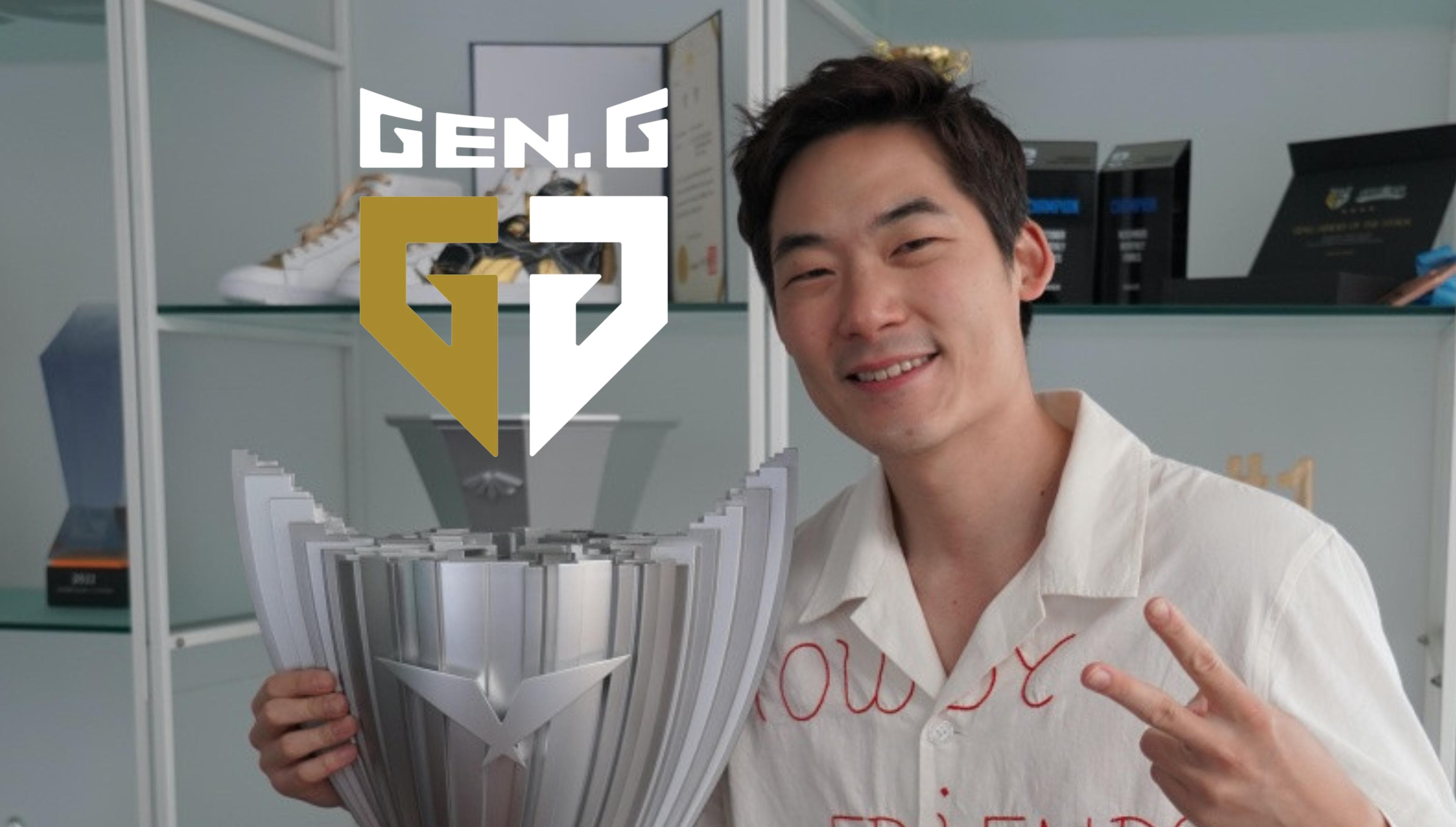
“I make more money losing than winning,” Gen.G's CEO Arnold on League's economic crisis
In an interview with TraYtoN, Gen.G CEO Arnold Hur opened up about the economic challenges of running a Korean powerhouse, the structural dysfunctions plaguing the esports ecosystem, and what truly sets Gen.G apart in today's competitive landscape.
00
Teilen
Arnold Hur joined Gen.G in 2017 after stints at Goldman Sachs, Boston Consulting Group, and Google—where he organized League of Legends tournaments with engineers while building product features.
"Riot has cut esports costs by approximately 40% over the past two years, while LCK team salary costs have simultaneously increased"
Loading...
Loading...
On December 26, Gen.G CEO Arnold Hur sat down with French streamer and former pro player Jean "TraYtoN" Medzadourian for an extensive conversation about the state of League of Legends esports, revealing candid insights about financial sustainability, roster management, and why French fans have become some of Gen.G's most passionate supporters.
In the middle of the interview, Arnold share a few transfer‑market gossips. He reveals one major name they seriously eyed but never got: “Years and years and years ago, like early days, TheShy (Kang Seung-lok) was on the list,” he says, laughing that LPL and LCK budgets were so different that “I don’t think we were even close”. When asked the inevitable question about Lee "Faker" Sang-hyeo, he is categorical: “No, it wouldn’t make sense for him first off. Clearly he’s the face of not just T1 but also of SKT and of esports in general”.
The harsh economics of competitive League
Arnold’s most striking comments are about the broken economics of League of Legends. “The biggest problem is that there is no incentives,” he says. “I will make more profit creating a losing team in League of Legends than I would creating a winning team… that’s a messed up system”. He insists teams share responsibility with Riot: “Every single time everybody always wants to blame Riot but in reality all of us are to blame for it”.
He claims Riot has slashed its esports spending while teams’ salary bills climbed. “I think Riot’s cut their esports cost in the last two years by about 40%. LCK, the average team salary costs have gone up in those two years,” he estimates, pointing to a system where “at the high end, prices are getting out of control” while “at the low end people are spending less than ever and just kind of mailing it in”. The consequences are visible: “I’ve had three different teams in Asia, even in the LCK, approach me about trying to sell their team or buy their team and they couldn’t find any buyers. [...] We’re pretending like things are okay”.
To him, the "original sin" of esports is that even a near‑monopoly platform like Twitch couldn’t make esports profitable. “How can you own a monopoly on the entire ecosystem of esports and still not turn a profit? That is… the original sin of esports that we still haven’t fixed,” he says, arguing that everything else—salary caps, co‑streaming debates, league formats—is secondary if core content doesn’t generate enough revenue.
Salary transparency, Canyon and competitive integrity
In a landscape where money doesn’t add up, Arnold pushes for radical transparency. “I’m all for having public salaries of players. Let’s go do it. I’ll vote yes every single time. None of the other teams do though,” he notes, adding he would even support leagues publishing team P&Ls so “we wouldn’t have all this nonsense about stuff that just doesn’t make sense”. He attributes some resistance to executives who aren’t owners and “are just like managing their P&L… trying to protect their jobs” if numbers look bad versus rivals.
One of the most human moments is when he talks about Kim "Canyon" Geon-bu’s deal. “It sucks that Canyon signed for a hell of a lot less than he needed to,” he admits. “He could have had better offers for sure… I’m not going to say from where, you guys can figure that out”. Still, he refuses to guilt players into discounts: “I don’t want to have a conversation ‘you like me, you like us, take less salary.’ That’s a stupid conversation”.
What Gen.G can offer instead, he says, is an environment: “Players know that there’s a certain culture that we have that is dedicated to winning. We have a certain amount of respect for every single player that goes from top to bottom”. Even for basic content shoots, the org asks them: “We ask the player, like, hey, we want to do this… just the fact that they know they can say no already is something”.
Worlds heartbreak, mental health, and treating players as adults
The loss at Worlds still lingers for Arnold. “This one in particular really hurt,” he confesses, describing how he stayed an extra day after the elimination and “spent a full day just thinking… in pitch black” about what Gen.G needed to change. His instinct wasn’t to wallow but to problem‑solve: “My first thought is always, what do we need to do to get better?”. Out of that came a revamped approach to data, performance coaching, and how the org supports players with health and mental training.
On protecting players from toxic fans, he pushes back against the idea of total shielding. “These are young men and young women. We need to start treating them as such and not being like, oh they just need all the protection,” he argues. You cannot “create some sort of artificial bubble around the player” given DMs and social media. Instead, Gen.G focuses on giving them tools: reframing how they read hate (“you’re reading it in your voice… versus if you saw somebody crazy on the street”), building phone‑free blocks, and even simple tricks like not installing Reddit or X apps to add friction.
He’s openly frustrated by narratives that infantilize pros. “I fundamentally disagree with the idea that it’s the org’s job to tell a player what to do,” he says. “If you treat children like children, they’ll be children versus if you treat them like the adults they are, and give them the tools so they can be better adults, then they’re gonna be set for life”. That philosophy, he believes, is part of why players often re‑sign with Gen.G even on less‑than‑maximum offers.
The moment that defines Gen.G
Asked for his best memory as Gen.G CEO, Arnold doesn’t pick a trophy or a big signing. Instead, he recalls a bad day when “everything went wrong in the company” before a team dinner. A player, without naming him, who had left for another org and later returned came up to him and said: “My time here at Gen.G was the most memorable, the best season I’ve ever had”. For Arnold, that’s the benchmark: “If we could do that for every player that we have… regardless of the results then we’ve built something really special”.
Looking ahead to 2026 with Canyon, Jeong "Chovy" Ji-hoon and Park "Ruler" Jae-hyuk, he hopes that season can be exactly that—“maybe with a World Championship at the end,” as TraYtoN suggests.