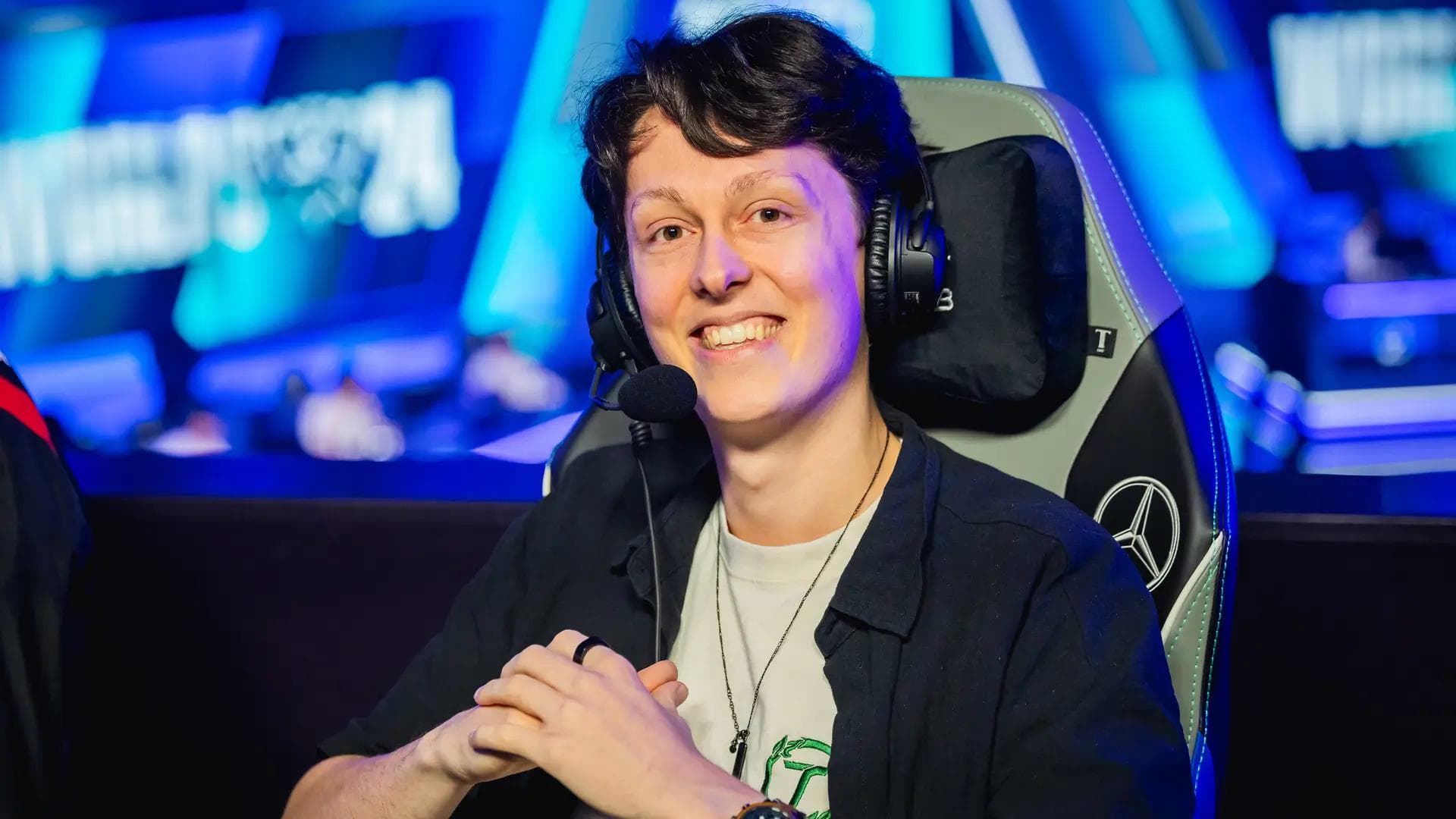
After topping their group and successfully rooting out
from the
EMEA Masters,
have advanced to the playoffs, with
now
standing in their way in the first round. Even more noteworthy, the
Prime League has successfully qualified all four of its teams to this stage, a first in its history. Amid this rise,
Sheep Esports sat down with team president and influencer
Niklot "Tolkin" Stüber to discuss the state of the ERLs, the changes he would like to see, and the future of German
League of Legends.
The Prime League has seen quite a resurgence this year. What factors contributed to the German ERL’s resurgence this year?
Niklot "Tolkin" Stüber: “This year, there are lots of German “GOATs” coming back to the scene—lots of ex-LEC players and veterans returning and forming teams.
I’m a bit biased since I started a project with G2 NORD. Our idea from the start was to kind of copy Caedrel
(Marc Robert Lamont)—create a German team where I’m the coach and go full
, but German style, like NNO
(No Need Orga) with a big streamer team being broadcast all the time.
Interestingly,
and
really contested the German player pool in tryouts and tried to do something similar, which made the scene more compact. So we had to look for players from other regions and built a stronger team overall, especially after we got
Nicolas Perez on board as our coach.
I also definitely feel that having an LEC-affiliated team like G2 NORD in the league gave it more attractivity in some ways. There was a surge of interest, with players and teams becoming more motivated, and brought in a lot more eyes, even in terms of more international viewers.
Despite strong performances, the Prime League is quite financially unstable, especially with Freaks4U’s bankruptcy. With uncertainty around its future, how do you feel about where the league is right now, and where it’s headed?
Tolkin: Yeah. Freaks4U is bankrupt and has essentially disbanded. Now there’s a new organization, backed by German tech giants like Saturn and MediaMarkt, which is why we now have an offline production in Berlin. That’s pretty cool, but it’s definitely smaller. This new company is still led by many of the same people from Freaks4U, so it’s not that different at least.
This season, it feels like there’s more regional interest in promoting the league than before. Germany has always struggled with local patriotism, partly because of its history, which makes it harder for fans to fully rally behind a national league. That’s why teams like Spandau have tried to push a more regional identity. To go back to your question, it’s definitely a worrying trend for esports overall, with leagues going bankrupt or undergoing major structural changes.
How do you feel about the German fanbase in LoL esports? Compared to French and Spanish communities, it feels less visible, especially with the disappearance of medias like Summoner’s Inn. Why do you think that is?
Tolkin: If we only look at viewer numbers in Europe, especially English ones, the second-largest audience is usually German. We’re just not as proud of our language or nationality as French or Spanish fans, so we don’t really rally around specific teams. Even back in the Summoner’s Inn days, there was never really
that one German LEC team which fans could rally behind.
is technically German, but nobody sees them that way—they’re just a European team with a Berlin HQ.
It’s hard to build hype around German teams.
, for example, is fun to watch, but people tune in for players like
or
, not because it’s a German team. We also only have two German players in the LEC, so it’s difficult to boost attention. Meanwhile, French and Spanish scenes just have an advantage in both marketing and competition, with more easily marketable teams and identities.
At
, we’re trying to do more on the content side. We’re planning a bootcamp later this month and want to do more to address the German audience. We’ll also be co-streaming more with my German players in the LEC so people can connect more with the Academy side of things.
How do you see your role as a streamer and content creator in supporting German esports? Do you actively think about how you present content and the impact you can have on growing the scene?
Tolkin: I’ve tried—especially when the LEC arena was restructured and there were a lot of co-streamers—to bring in as many guests as possible. I really believe that the more people streaming or co-streaming, the better it is for everyone. In Germany, it’s like the idea that the “cake” just gets bigger for everyone.
That’s why, over the past couple of years, I’ve had as many guests as possible, especially in person. Nowadays, I still put thought into what I choose to broadcast. Usually it’s all of the LEC, plus the big Prime League matches, but the schedule makes it hard to cover everything consistently.
I also try to support smaller German pro players—especially those from my own environment like
and
—by raiding them and helping them build an audience. The idea is that they can grow a fanbase, and in turn attract more attention when they reach the LEC.
Germany is a large market with a strong economy and population, but there’s not as much content or fandom compared to its potential. The way to change that isn’t just at the org level—it’s about creating personalities people can connect with. It shouldn’t just be “I’m a G2 NORD fan,” but rather starting with players or creators you like, and then naturally following teams around them.
In a way, it’s similar to how things used to be in the early days of pro play, when many players were streaming their own games. We’re slowly moving back toward that kind of ecosystem.
Back in the day, it felt easier for players to build a name for themselves, but nowadays many players struggle to build a strong personal brand or visibility. Why do you think that is?
Tolkin: I believe too many players in the last couple of years haven’t really adapted. In Europe, there’s often this idea that we’re not working hard enough to match the Koreans, but we’re also not creative enough, and we don’t invest enough in content.
Why that is, I’m not entirely sure—there should be time for it. Some teams do try, and some players stream a lot, but a big reason is just League of Legends fatigue. It’s not that League is dying—it’s more that there are too many leagues and too many games competing for attention. You can’t follow everything, and players also don’t always have the time or energy to stream on top of everything else.
Even as someone who co-streams a lot and follows multiple regions, my audience can’t keep up with everything either—LPL, LCK, LEC, Prime League, all at once. So when new players come in, they really have to stand out to get noticed.
The best way to do that is to be both skilled and entertaining. You need to be good at the game, but also have a personality that draws people in. And on top of that, you need an initial audience—something that makes people interested in the first place.
Do you think League fatigue started because of structural changes like the three-split format, or are there broader reasons behind it?
Tolkin: I don’t think it’s really League-specific. It feels more like a broader trend across entertainment. Many formats have already figured out what works, and now instead of focusing on quality, there’s a push toward quantity. You see major franchises being expanded or reworked—like Harry Potter or Lord of the Rings—and even in sports, there are more games than ever. In football, for example, there’s been criticism about players getting injured more often because of the increased number of matches.
So overall, it’s a wider phenomenon where all forms of entertainment are producing more content to compete for people’s attention.
Back in 2018–2019, we had multiple leagues at the same time—Premier Tour, Summoner’s Inn League, and ESL Meisterschaft. There were big weekly matchups that people really cared about, like EURONICS against mousesports. But because there were so many games, individual matches didn’t always feel as meaningful anymore—you might beat a team one week and face them again the next.
So I’m not entirely sure if the three-split format itself is too much. I don’t think that’s the core issue. The fatigue comes more from the ecosystem around it. If the same co-streamers are covering every league, across every region, then the core esports audience ends up being overloaded. It’s not necessarily the leagues themselves—it’s the overall consumption of content that leads to fatigue.
Do you think the current ERL format works for viewership retention and building fan bases, given the competition from Tier 1 leagues? Or are broader changes needed?
Tolkin: That’s a deep question. I can only answer on a surface level because I don’t know enough about other teams’ financial situations.
From my view, in terms of viewership retention, the German teams I follow at ERL level—like BIG and G2 NORD—are doing great. It’s also good because we’re going far at EMEA Masters, and reaching playoffs is already a positive sign. But if you talk about broader changes, that includes teams who haven’t made EMEA Masters, the lower ones. For them, viewership isn’t as great at all. If you don’t have a fan base, it’s difficult, and these days you only really build one if you have streamers attached to the project. For Eintracht Spandau, that’s
HandOfBlood (Maximilian Knabe); for G2 NORD, it’s me.
When it comes to broader changes, it’s hard to say how you implement them. In the past, projects in regional esports were always born from passion. It wasn’t really meant to be a full-time financial career, but rather a stepping stone toward LEC. Now, though, many players in ERLs—and teams like
—are former LEC players who dropped out and are now playing ERL as a full-time job.
So I think the scene is, in some ways, going back toward its origins, where younger players who are less dependent on finances are meant to take over. But that’s difficult, because there aren’t as many younger players left.
Do you feel like the professionalization of esports ended up hurting it more than it brought good changes, especially at the ERL level?
Tolkin: When the professionalization of esports came, it really felt like a gamble—it was maybe a 50-50 whether people would commit to it.
At the time, big German TV broadcasters wanted to enter esports and have professional studios and setups. Summoner’s Inn built a studio that fit those needs, almost like a traditional TV production environment. But when the pandemic hit, that changed how people consumed content. Content creation became much more reaction-focused, and people started watching more casually—sometimes just watching videos with friends while being at home—rather than engaging with highly produced formats.
Because of that shift, the “gamble” didn’t really pay off. In that sense, professionalism did hurt League of Legends leagues and the content ecosystem to some extent, but it was hard to foresee at the time. I was just an employee casting games back then, not making decisions, but I could understand why organizations moved in that direction.
There were also attempts like ProSieben entering esports and even trying to build their own platform, Joyn, to compete with Twitch and bring streaming under a more traditional media model. They also worked with streamers and tried to professionalize that space, but it didn’t work out as intended. Overall, it really felt like a 50-50 situation back then.
What is your opinion on shifting ERLs toward a more grassroots model and introducing an LEC Second Division instead? You could have regional leagues serve as qualifiers for it.
Tolkin: I believe the best way to change ERLs would be to make them more international all the time, because that’s the easiest way to market them. A second division of LEC would basically mean the best French teams, German teams, Spanish teams, and Scandinavian teams facing each other constantly. That’s just so easy to market—it’s like a constant EMEA Masters or Champions League, with always ongoing storylines and national interest.
Back when I started watching and playing esports as a teenager, I always felt the strength of esports was that you didn’t have to be in the same place—you could connect internationally through the internet, have friends from different countries, and still be part of the same scene.
But in practice, marketing has shown that purely international teams don’t really work as well. National identity still plays a big role—teams rely on local sponsors, local co-streamers, and regional fanbases. So a second division made up of the top teams across regions, who are also full-time, would make sense to me. Meanwhile, other leagues would likely no longer be full-time, which is already a direction we’ve seen in Germany. For example, the second division of Prime League used to have full-time contracts a few years ago, but that’s no longer the case.
Maybe with something like League Next in 2027, changes could help attract younger players. That’s important, because without full-time employment, only younger players can realistically commit. When I started playing at a grassroots level, I was around 14 or 15 years old, and I wouldn’t have been able to do that if I had to pay rent back then. Going back to a grassroots model is quite difficult if the main player base is older.
Have you noticed a decline in younger talent coming into Prime League and less interest in esports overall in Germany?
Tolkin: I definitely think so. There are fewer people being interested. Back when we were in school, League of Legends was the hot game—everyone was talking about it. I haven’t been in school for years, but I imagine it’s quite different now. That’s not really specific to Germany; it feels like it’s the same across Europe.
That’s why I mentioned League Next as a hopeful idea. Maybe projects like that can change how people see the game or bring new players in, because the game itself is still the greatest game I’ve ever played. Many of us have dedicated a lot of time to it over the years, so a new hype wave would be great.
But to answer the question: yes, there is definitely a smaller younger talent pool. We still have some players coming up—like
, a 22-year-old who I think has been doing well, and Shelfie, who is still a teenager. It’s interesting to see players like that, and also how mature they are.
In a way, younger players today are more mature than players used to be. I think that’s because they’re growing up in a more difficult environment. They realize that if they behave too emotionally or immaturely, they won’t continue to progress, because teams tend to favor veterans. So they adapt faster and take things more seriously.
That pressure can actually help some players develop a lot—it pushes them to improve. And I think in Shelfmade, for example, we’ve found a diamond. Obviously, I’m biased with G2 NORD, but he’s been doing really well. So yeah, we’ll see what happens.
You did beat , so that's a pretty good sign, right? And there’s that next match against coming…
Tolkin: It is, it is. And I do believe that next matchup against French Flair will be really interesting. This is a team—I mean, it’s always fun. I really like
Trayton (Jean Medzadourian), and it’s kind of funny to have two G2 streamers meet already in the first round of playoffs.
We’ve played French Flair a lot. It was the first team we ever scrimmed, and they beat us 5–0 about three months ago. We kept scrimming them because they were also willing to do scrims on stream. Then they started canceling some scrims after they lost a couple of games—classic.
It’s going to be great fun against them, and I do respect the team a lot. Recently, I think we should have a good record against them.
Finally, what is your role within G2 NORD, and how do you see your impact on the German scene through this project? Is this for you a way to give back to the community that made you into who you are?
Tolkin: Yes, it’s definitely one of the main lines of thought for me. I’ve kind of done everything in the German scene now—from fan, to player, to coach, to owner, to streamer, to commentator.
Right now, my role has shifted more into that of a president. I was heavily involved in tryouts, watching every game and helping decide which players to pick. Initially, we wanted to do a Los Ratones-style project with German-only players, but since we took a different direction, my role changed accordingly.
Now I’m less directly involved like a coach would be, but I still give feedback on games and stay in contact with the players. At the same time, I try to put a spotlight on younger talent as much as possible. That’s always a bit difficult, because in a project like this you don’t have promotion or relegation into the LEC.
The players you build up and highlight are usually the ones who perform well—and those players will eventually leave. So in a way, the project always feels like it’s on a timer. It’s not that G2 NORD will disband or anything—we want to continue this for many years—but our best players are meant to move on.
I want
to go to the LEC. I don’t want him to stay forever. The same goes for players like
,
,
, and
. Because of that, it’s always a bit difficult to build long-term attention when your strongest players typically leave after a year.”